Where Are VPNs Legal? VPN Laws by Country (2026)
Where are VPNs legal? Almost everywhere. See which countries ban VPNs, which restrict them (China, Russia, Iran, UAE, Turkey) and what travellers need in 2026.
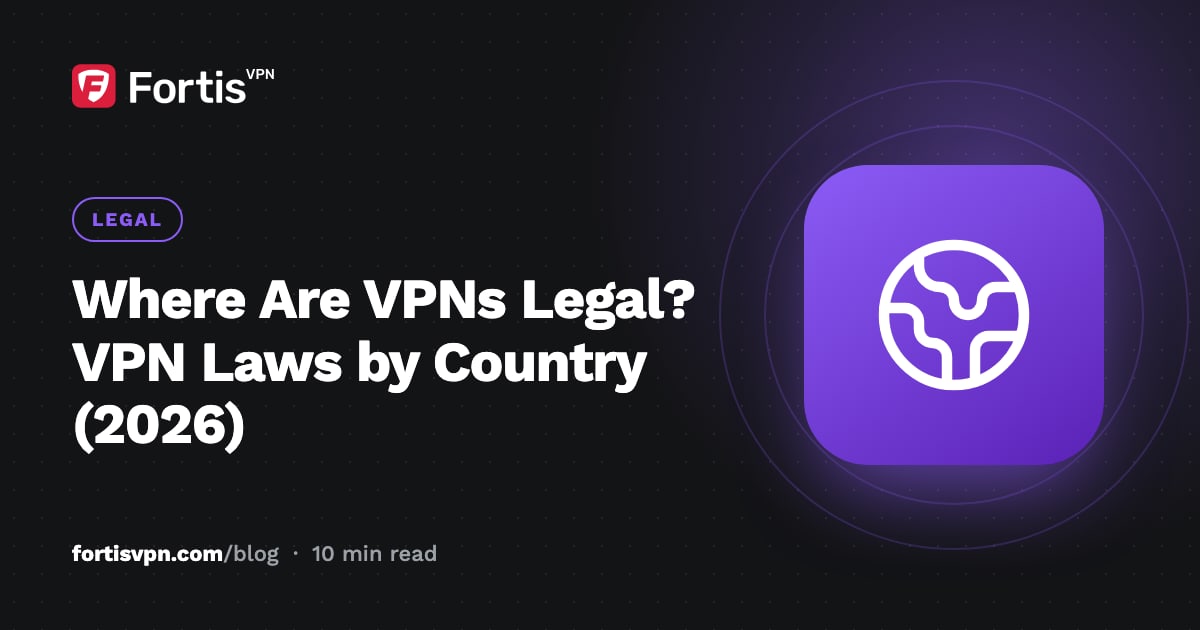
VPNs are legal in the large majority of countries, including every country in the EU, the UK, the US, Canada, Australia and Japan. A small group of states bans or effectively bans them: North Korea, Turkmenistan, Belarus and, since 2025, Myanmar. A larger group allows VPNs but restricts them, by licensing providers, blocking VPN sites, or punishing misuse: China, Russia, Iran, the UAE, Saudi Arabia, Qatar, Egypt, Turkey, Oman, Pakistan and India. The tables below give each country's status, last checked October 2026.
- Most countries have no VPN-specific law; using one is as legal as using HTTPS.
- Four countries ban or effectively ban VPNs; around a dozen restrict them in some way.
- "Restricted" usually means blocked sites or licensed providers, not fines for ordinary use.
- Everywhere, a VPN does not make an illegal act legal; the act is what gets prosecuted.
How VPN laws usually work: use versus misuse
Almost no country has a law that says "VPNs are illegal". Laws instead do one of four things:
- Nothing special. The VPN is a normal piece of software. Crimes committed over it are prosecuted as crimes. This is the rule in most of the world.
- Punish misuse. The law adds a penalty for hiding your IP address while committing an offence. The UAE is the clearest example.
- Restrict providers. Only licensed or state-approved VPNs are allowed, or providers must keep logs and filter content. China, Russia, Iran and Pakistan do this.
- Block access. The state blocks VPN websites, server addresses or protocols so that VPNs are hard to get or use, without passing a law against users. Turkey, Egypt and Saudi Arabia sit here.
Our guide to whether it is legal to use a VPN covers the general principle. The country notes below are the exceptions.
Countries where VPNs are banned or nearly banned
| Country | Status | What it means in practice | Last checked |
|---|---|---|---|
| North Korea | Banned | Ordinary citizens have no access to the global internet, only a state intranet. VPNs are irrelevant for residents and unavailable to visitors on local networks. | October 2026 |
| Turkmenistan | Effectively banned | The state ISP has blocked VPN services systematically since 2019. Human Rights Watch reports fines, arrests and administrative sentences for people who install VPNs for others. | October 2026 |
| Belarus | Effectively banned | A 2015 decree lets the state add anonymisers, including Tor, to the blocked list. VPN services were disrupted around the January 2025 election, and sharing material from channels classed as "extremist" is prosecuted. | October 2026 |
| Myanmar | Banned for unlicensed services | The Cybersecurity Law enacted on 1 January 2025 sets up to six months in prison and fines of 1 to 10 million kyat for unauthorised VPN installation or services, as Radio Free Asia reported. Legal analysts disagree on whether it reaches individual users or only providers. | October 2026 |
| Iraq | Unclear | A 2014 ban is still widely cited, but Freedom House found no formal nationwide prohibition in 2024. ISPs have been directed to block VPN traffic at times. Treat it as restricted. | October 2026 |
Countries where VPNs are legal but restricted
In every one of these countries ordinary people use VPNs daily; the restrictions bite on providers, specific content or specific uses.
| Country | Status | What it means in practice | Last checked |
|---|---|---|---|
| China | Only state-approved VPNs | 1996 rules forbid unapproved international channels, with fines up to 15,000 yuan. Enforcement targets sellers, but individuals have been fined, and in 2023 a programmer had over 1 million yuan of foreign earnings confiscated. Foreign VPN sites and protocols are blocked. See does a VPN work in China. | October 2026 |
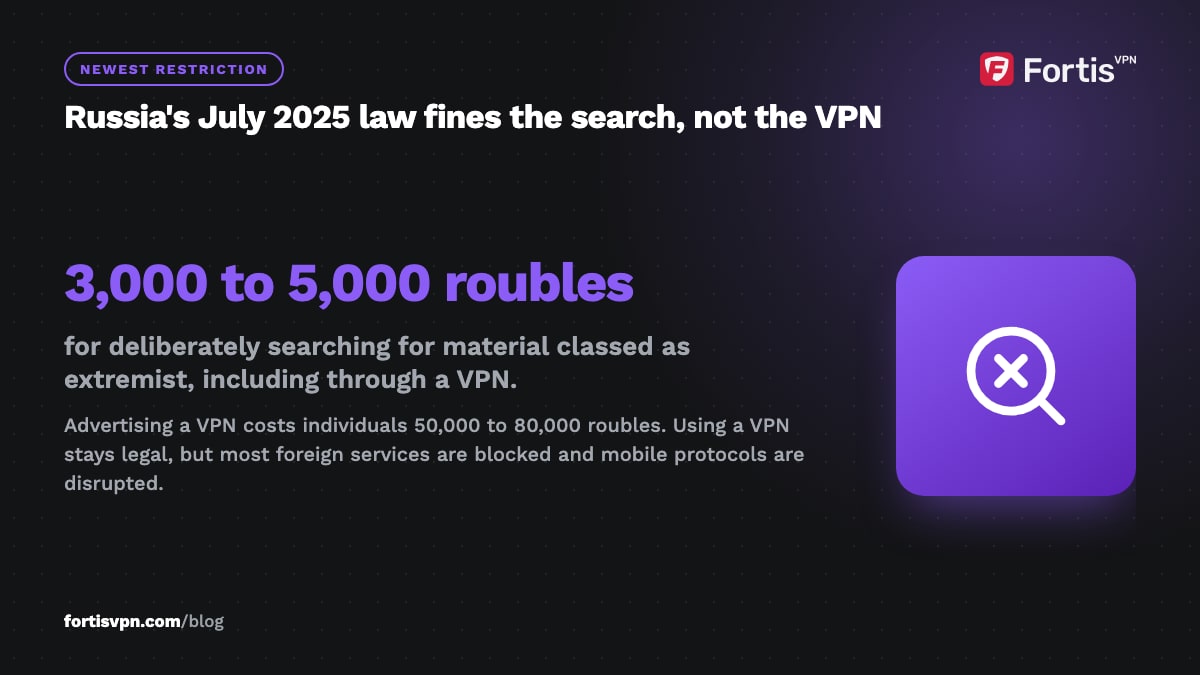
| Russia | Legal to use, providers restricted | Since 2017 VPNs must connect to the state blocklist or be blocked; most foreign services are. A law signed in July 2025 fines deliberately searching for "extremist" material, including through a VPN, 3,000 to 5,000 roubles, and VPN advertising 50,000 to 80,000 roubles for individuals. WireGuard and OpenVPN have been disrupted on mobile networks since 2023. | October 2026 |
| Iran | Licence required | Buying and selling VPNs was already illegal; a February 2024 Supreme Council of Cyberspace resolution extended the ban to using VPNs without a licence. Sources disagree on whether it created criminal penalties. In 2026 Iran moved to a tiered internet with a paid tier for approved users. Expect heavy blocking. | October 2026 |
| UAE | Legal; misuse punished | Article 10 of Decree-Law 34 of 2021 sets AED 500,000 to 2,000,000 and/or prison for masking an IP address to commit or hide a crime. Lawful use is fine. Internet calling in unlicensed apps is restricted. See VPN in the UAE. | October 2026 |
| Saudi Arabia | Legal; content offences punished | The 2007 Anti-Cyber Crime Law does not mention VPNs. Some VPN sites are blocked and calling apps restricted. See VPN in Saudi Arabia. | October 2026 |
| Qatar | Legal; content offences punished | Law 14 of 2014 has no VPN offence. Some VPN sites blocked; app calling restricted. See VPN in Qatar. | October 2026 |
| Egypt | Legal; blocked content disputed | Law 175 of 2018 names no VPN offence, but Article 14 is read by some lawyers to cover accessing blocked sites. Hundreds of sites and several VPN protocols have been blocked. See VPN in Egypt. | October 2026 |
| Turkey | Legal; providers blocked | No offence for users. The BTK ordered 16 VPN services blocked in late 2023; social media is throttled during political events. See VPN in Turkey. | October 2026 |
| Oman | Restricted for individuals | The regulator (TRA) has warned against personal VPN use, most recently in 2026, and routes business VPNs through local ISPs. A 2010 draft regulation proposed a 500-rial fine for individuals, but its enacted form is unconfirmed, and local legal commentary stresses that liability turns on what the VPN is used for. | October 2026 |
| Pakistan | Registration regime | A November 2024 deadline to block unregistered VPNs was dropped for lack of legal basis. Since December 2024 providers need a class licence; by January 2026 nine were licensed and over 30,000 businesses and freelancers had registered. Personal use is not an offence. | October 2026 |
| India | Legal; data rules for providers | April 2022 CERT-In directions require VPN providers to keep customer records for five years. Several international providers removed their Indian servers instead. Using a VPN is legal. | October 2026 |
Countries where VPNs are legal with no special rules
This is most of the world. VPN use is lawful and unremarkable in:
- All 27 EU member states, the UK, Switzerland, Norway and Iceland.
- The United States, Canada, Mexico and nearly all of Latin America.
- Australia, New Zealand, Japan, South Korea, Taiwan, Singapore, Malaysia, Thailand, Indonesia and the Philippines.
- South Africa, Nigeria, Kenya, Ghana, Morocco and most of Africa.
- Israel, Jordan, Lebanon and Kuwait in the Middle East.
Two caveats. First, "no special rules" does not mean "no rules": copyright, fraud, harassment and hacking laws apply as normal. Second, a few countries outside the tables, Tanzania since October 2023 for example, ask VPN users to declare or register their use, and others block specific websites or apps for periods without any law against VPN users. Expect the list to change.
What "restricted" means for travellers
If you are visiting a restricted country for a week, the practical consequences are usually mundane:
- You may not be able to download or sign up locally. Provider websites are blocked in Turkey, Egypt, Saudi Arabia, China, Russia and Iran. Install and log in before you fly.
- Some protocols may stall. Switch to OpenVPN TCP on port 443 or an obfuscated server, which look like ordinary HTTPS. Our blocked network guide covers the steps.
- Calling apps may not work. In the Gulf, internet calling in unlicensed apps is restricted by regulators, and a VPN does not change the licensing position. Use a local SIM for important calls.
- What you do matters more than the tool. Reading blocked political content in Iran, China or Belarus carries real risk for residents and, during unrest, for visitors. Lawful uses such as banking, email and work carry no documented risk.
How to stay on the right side of the law anywhere
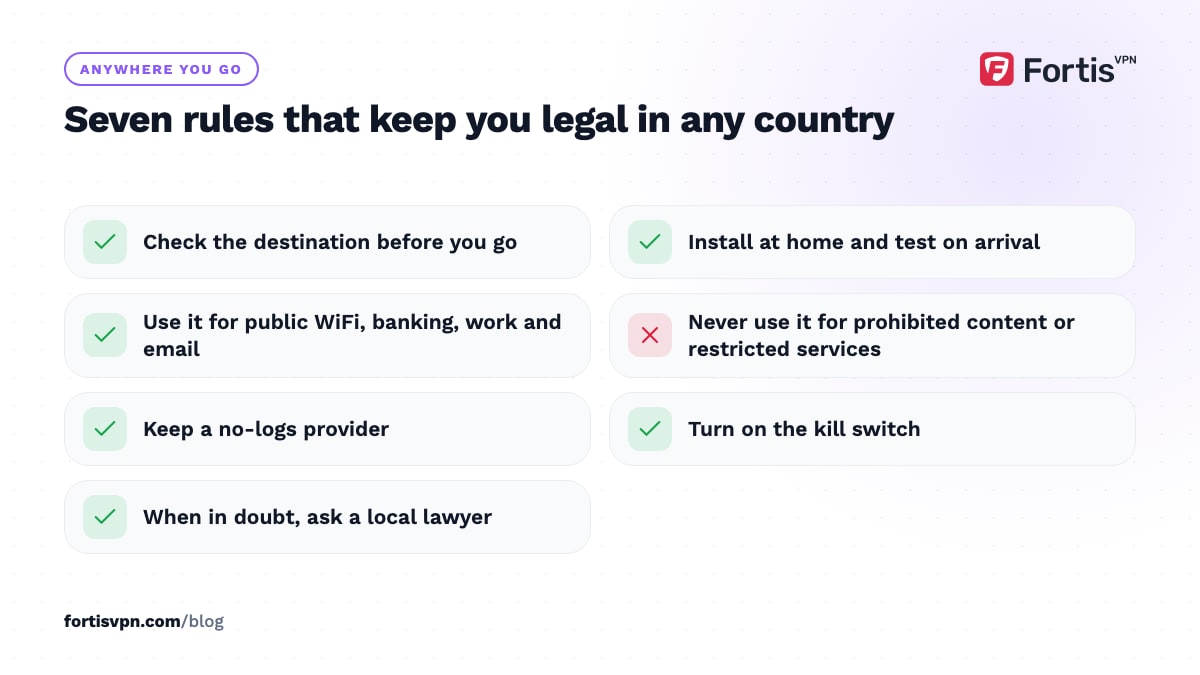
- Check the destination before you go. Use this table and the country guides.
- Install at home, test on arrival. Have the app, your login and a fallback protocol ready.
- Use the VPN for security and privacy. Public WiFi, banking, work and email are lawful everywhere VPNs are allowed at all.
- Do not use it to reach prohibited content or restricted services. That is where every "VPN fine" story actually comes from.
- Keep a no-logs provider. A provider with nothing stored has nothing to hand over; see what a no-logs policy means.
- Turn on the kill switch. A dropped tunnel should never silently expose your traffic on a hostile network.
- When in doubt, ask a local lawyer. Laws in this area change quickly; this page is a snapshot.
This article is general information, not legal advice.
Using FortisVPN when you travel
FortisVPN works on Windows, Android, Android TV, Google TV and Fire TV, with one account covering up to 10 devices and servers in 100+ countries for home-country banking wherever you are. The apps keep no activity or connection logs. Protocol choice is in Settings on every app: Auto for most networks, OpenVPN TCP on port 443 for networks that interfere with VPN traffic, as shown in the protocol guide. Download and sign in before you travel from the download page, since provider websites are blocked in several of the countries above. Every plan has a 7-day free trial and a 30-day money-back guarantee, so you can start a free trial before a trip.
Frequently asked questions
Which countries ban VPNs completely?
North Korea, where there is no public internet, and Turkmenistan, where the state ISP blocks all VPN services and punishes people who install them, are the clearest cases. Belarus blocks anonymisers by decree and cut VPN access around its 2025 election. Myanmar's 2025 Cybersecurity Law penalises unauthorised VPN services. Iraq's status is unclear. Everywhere else, VPNs are legal in some form.
Is it illegal to use a VPN in Europe or the US?
No. Every EU member state, the UK, the US and Canada allow VPN use without restriction, and none has a VPN-specific law. Ordinary laws still apply to what you do: copyright infringement, fraud and harassment are offences with or without a VPN. Some streaming services and websites block VPN traffic under their own terms, which is a contract matter, not a legal one.
Can I get in trouble for using a VPN while travelling?
Not for lawful use in any country that permits VPNs, which is nearly all of them. Risk comes from what you do through the VPN: prohibited content, restricted calling services, or posts that are offences locally. In China, Iran, Russia and Belarus, keep use to banking, work and email. In the Gulf and Turkey, the same rule keeps you comfortably within the law.
Why do some countries ban or restrict VPNs?
Mostly to make national internet blocking effective. A government that blocks news sites, platforms or calling apps sees VPNs as a way around those blocks, so it blocks VPN websites, licenses providers, or punishes misuse. In the Gulf, protecting licensed telecom operators' calling revenue is a second reason. Security concerns about unknown VPN apps are often cited too.
Are VPN laws changing?
Yes, and mostly in the direction of more restriction. Between 2024 and 2026 Russia added fines for VPN advertising and for searching extremist material, Myanmar passed a cybersecurity law, Pakistan built a licensing regime, Iran extended its ban to unlicensed use, and Turkey's regulator sought explicit VPN powers. Check the date on any guide, including this one, before relying on it.
Last updated: 12 October 2026