Is VPN Legal in Egypt? Laws and What Gets Blocked
Is VPN legal in Egypt? VPN use is not banned, but Law 175 of 2018 and heavy site blocking matter. Penalties, blocked protocols and VoIP as of October 2026.
Using a VPN in Egypt is not illegal. No Egyptian law bans VPN apps, and Law No. 175 of 2018 on Anti-Cyber and Information Technology Crimes does not name VPNs. But Egypt blocks websites heavily, has interfered with VPN protocols and provider sites, and one article of the 2018 law can be read to cover accessing blocked sites. So the practical answer is: lawful for security, work and privacy; risky if you use it to reach what the state has blocked.
- VPN use is not criminalised in Egypt; the 2018 cybercrime law targets conduct, not tools.
- Lawyers disagree on whether Article 14 covers visiting blocked websites; its penalty starts at one year.
- Egypt has blocked hundreds of sites since 2017, and has interfered with PPTP, L2TP and OpenVPN.
- OpenVPN TCP 443 and obfuscated servers keep lawful connections working on filtered networks.
What Egypt's 2018 cybercrime law says about VPNs
Law No. 175 of 2018 came into force in August 2018. It is a long statute covering hacking, fraud, content offences, website blocking and the duties of internet providers. The word "VPN" does not appear in it. Four articles matter for VPN users:
| Article | What it does | Penalty |
|---|---|---|
| Article 2 | Requires providers to keep user and traffic data for 180 days and hand it over on request | Provider fines |
| Article 7 | Lets the investigating authority order a website blocked if its content is seen as a threat to national security or the economy; a court reviews the order within 72 hours | Not an offence for users |
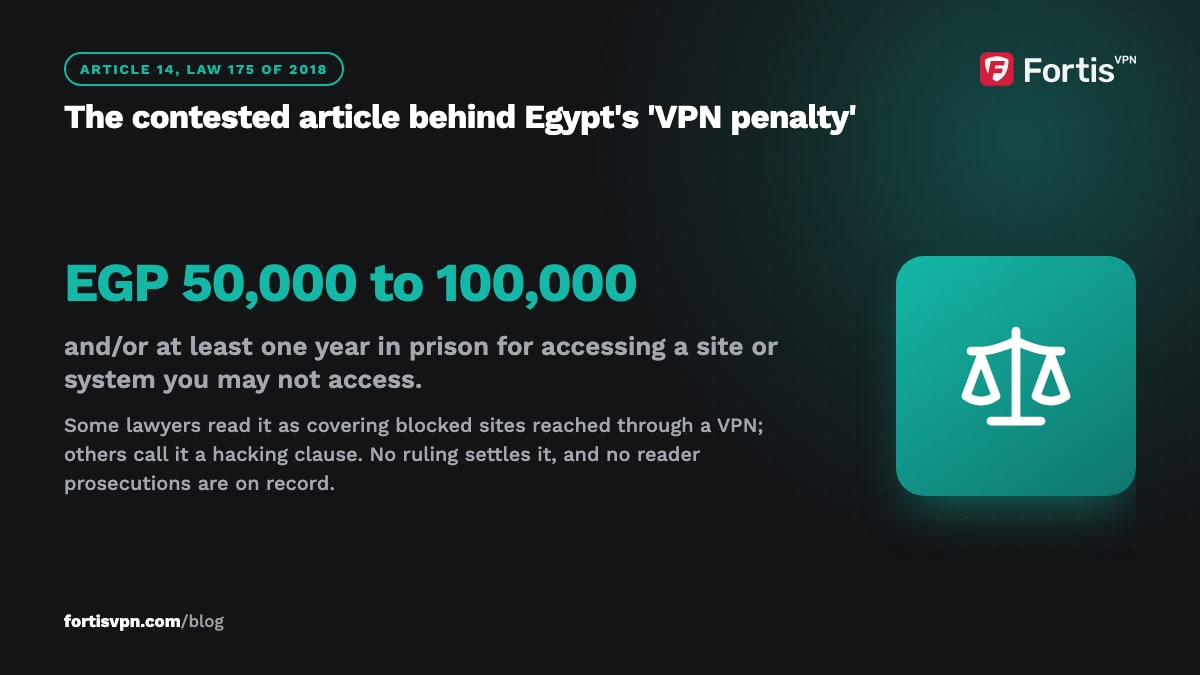
| Article 14 | Unlawfully accessing a website, private account or information system that you are not permitted to access | At least 1 year in prison and/or EGP 50,000 to 100,000 |
| Article 25 | Content that violates "family principles and values" of Egyptian society, privacy violations, unsolicited bulk messages | At least 6 months in prison and/or EGP 50,000 to 100,000 |
Article 14 is the contested one. Its wording targets access to a site, account or system "access to which is prohibited". Some Egyptian law firms read that as covering any blocked website reached through a VPN and call the one-year minimum "the VPN penalty". Other readings treat it as a hacking provision, since that is the chapter it sits in, and note that Article 7 sets out blocking without attaching any penalty to users who reach a blocked site. The sources disagree and no public ruling settles it. Published prosecutions under this law concern what people posted or accessed, not whether they had a VPN installed.
Digital rights groups have challenged broad readings of the law in court, including a constitutional challenge to Article 25. The Association for Freedom of Thought and Expression (AFTE) publishes a readable overview of the legislation.
What Egypt blocks
Egypt began large-scale website blocking in May 2017. By 2018 AFTE and the OONI measurement project had documented hundreds of blocked URLs, including news outlets, human rights organisations and VPN and proxy sites, with ISPs using deep packet inspection to reset connections. Their joint report on internet censorship in Egypt is the most detailed public record. Later counts from AFTE put the number of blocked sites above 500, and the regional digital rights group SMEX counted around 600 blocked websites and services between 2017 and 2020, roughly 400 of them VPN or proxy services.
The categories most often blocked:
- Independent and foreign news sites.
- Human rights and political opposition sites.
- VPN, proxy and anonymiser websites.
- Pornography and gambling.
- Some VoIP calling traffic, at various times.
Blocking orders are supposed to come from the investigating authority with court review under Article 7, and in 2022 the Court of Cassation ruled that only the telecom regulator (NTRA) may implement them. In practice, most blocks arrive with no announcement and no published list.
Legal uses and risky uses
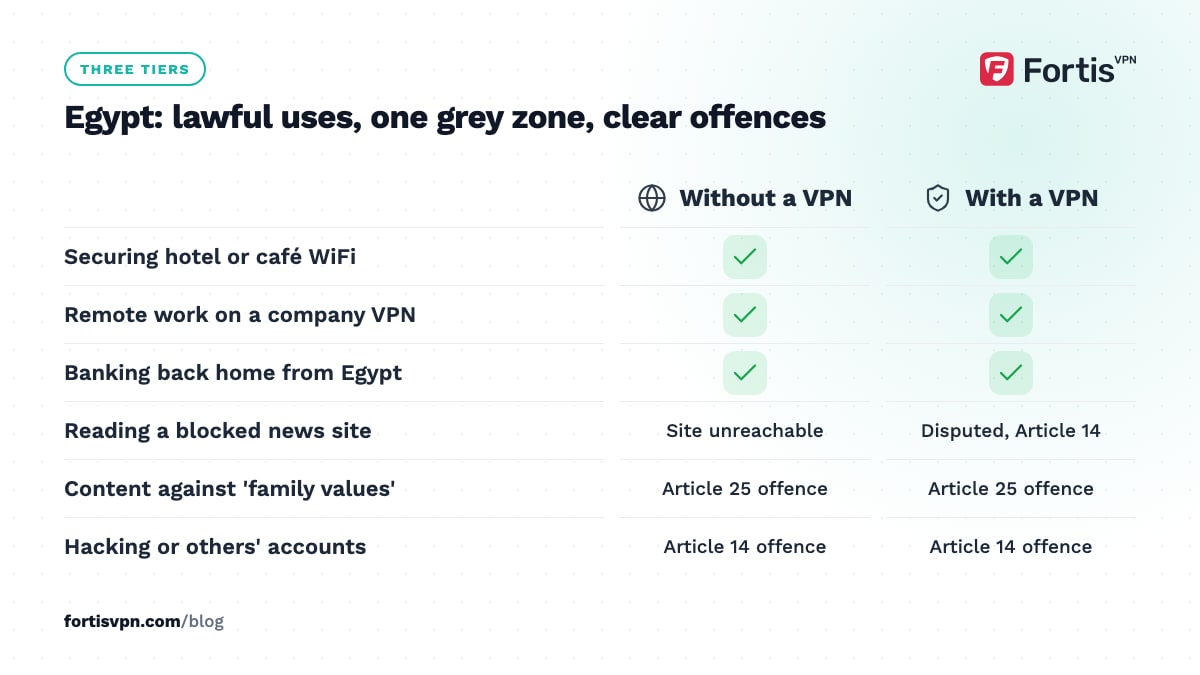
Lawful uses are the same as anywhere: encrypting your traffic on hotel and café WiFi, remote work over a company VPN, reaching your home-country bank while in Egypt, keeping trackers off your IP, and travelling with a VPN for security. Egyptian banks, outsourcing firms and government bodies all use VPN technology, and no law restricts it. The principle in our general guide to VPN legality holds: lawful without a VPN, lawful with one.
Risky uses fall into two groups. The first is clear: conduct that is an offence under Egyptian law stays an offence behind a VPN. That includes content caught by Article 25, which the Egyptian Initiative for Personal Rights says was used to arrest more than 300 people in over 250 cases between April 2020 and November 2025, mostly over videos and photos the courts found contrary to "family values". A VPN hides your IP from a website; it does not hide you from an investigation into something you published under your own name.
The second group is the grey zone: using a VPN to read blocked news or political sites. Whether that is an Article 14 offence is disputed, and public sources show no prosecutions of ordinary readers for it. It is still a risk you should weigh for yourself, and this article does not advise you to take it.
Are VPN apps or protocols blocked by Egyptian ISPs?
Yes, at times. Egypt has interfered with VPN traffic more actively than most countries in the region:
- In June 2017 the websites of five VPN services were added to the blocked list, and many more followed.
- In August 2022 ISPs began interfering with the PPTP and L2TP protocols.
- In October 2022 users reported OpenVPN connections failing on Egyptian networks, which SMEX attributed to deep packet inspection that identifies the protocol's traffic pattern.
- In June 2023 OONI measured a major VPN provider's services being blocked through TLS interference.
What this means in practice: VPN apps are still available and widely used, but a given protocol can stop working on a given network. OpenVPN TCP on port 443, which looks like regular HTTPS traffic, and obfuscated servers are the standard answers for keeping a lawful VPN connection alive on a filtered network. Our blocked network guide explains the order to try them in.
VoIP calls in Egypt
Internet calling has an uneven history in Egypt. In 2017 and 2018 users on several networks found voice and video calls in popular messaging apps failing while messages went through. Operators told customers VoIP was blocked under NTRA rules; the NTRA denied ordering a block. Since then, reports have varied by operator and by whether you are on mobile data, a data-only SIM or home broadband.
As of October 2026 there is no official list of permitted or blocked calling apps and no recent NTRA statement. Expect app calls to work on some connections and not others. If reliable calls matter, a local SIM with a calling bundle is the dependable option. A VPN is not a licensing workaround, and this article does not recommend using one to get around a calling restriction.
Advice for residents and tourists
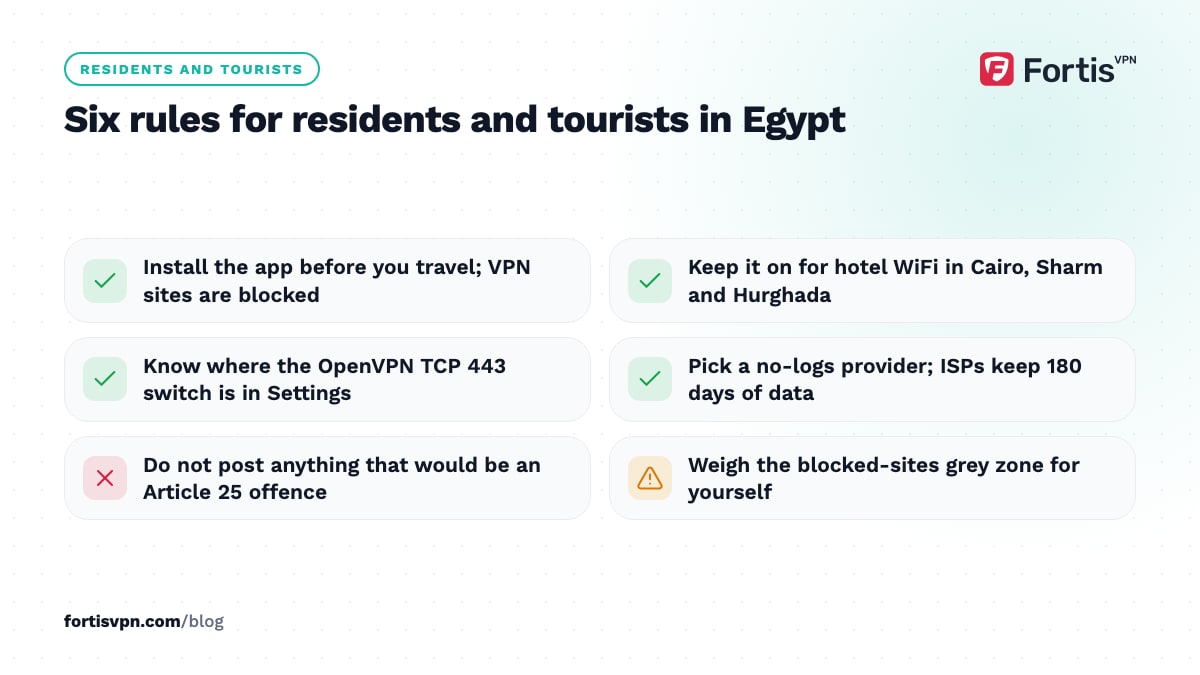
- Install before you travel. VPN websites are often blocked; installed apps and Google Play listings generally still work.
- Use it for security. Hotel WiFi in Cairo, Sharm El Sheikh and Hurghada is public WiFi. Keep the VPN on for banking, email and messaging.
- Keep protocol options ready. If WireGuard or OpenVPN UDP stalls, switch to OpenVPN TCP 443 or an obfuscated server. Our protocol guide explains each.
- Choose a no-logs provider. Article 2 makes ISPs keep 180 days of your traffic data; a VPN with a genuine no-logs policy has nothing equivalent to hand over.
- Do not post or share anything that would be an offence. Article 25 cases are real and frequent, and a VPN is no shield for content published under your name.
- Weigh the grey zone yourself. Reading blocked sites is legally disputed. Residents carry more exposure than short-stay tourists, and this article cannot make that call for you.
- Compare the region. The UAE and Turkey take different approaches; the VPN laws by country table lines them up.
This article is general information, not legal advice. For a specific situation in Egypt, consult a licensed lawyer.
Using FortisVPN in Egypt
FortisVPN runs on Windows, Android, Android TV, Google TV and Fire TV, with up to 10 devices on one account and no activity or connection logs. Because Egyptian networks have interfered with OpenVPN and other protocols at times, the apps let you switch to OpenVPN TCP on port 443 in a few taps; see the Android protocol guide. The kill switch on Windows stops traffic falling back to the open connection if the tunnel drops, and split tunnelling keeps local apps on your normal connection. Plans include a 7-day free trial and a 30-day money-back guarantee, so start a free trial and confirm the connection works on your Egyptian network before you commit.
Frequently asked questions
Can I be arrested for using a VPN in Egypt?
Not for the VPN itself. No Egyptian law bans VPN use, and public reporting shows no arrests for merely having or running one. Arrests under the 2018 cybercrime law concern what people published or accessed, most often under Article 25 on "family values". Using a VPN for security, work and banking carries no known legal exposure.
Does WhatsApp calling work in Egypt?
It depends on the network. Voice and video calls in popular messaging apps have been disrupted on Egyptian networks at various times since 2017, while messaging works. The regulator has not published a list of permitted apps, and experiences differ between operators and between mobile and home connections. For calls you can rely on, use a local SIM calling bundle.
Are VPN websites blocked in Egypt?
Many are. Egypt started blocking VPN and proxy websites in June 2017 and rights groups counted hundreds blocked by 2020. Installed apps usually keep connecting because they reach server addresses directly. Set up your VPN before arriving, and keep OpenVPN TCP 443 or an obfuscated server as a fallback in case a protocol is interfered with.
Is a VPN safe for banking in Egypt?
Yes, and it is a sensible precaution on public WiFi. Connect to a server in the country where your account is held so the bank does not flag the login, and keep the kill switch on so a dropped tunnel never exposes the session. Egyptian banks use VPN technology themselves, and no law restricts you doing the same.
Which protocol works in Egypt if VPNs are blocked?
No protocol is guaranteed, because interference changes. OpenVPN TCP on port 443 is the usual first choice, since it looks like ordinary HTTPS traffic that ISPs cannot block without breaking the web. Obfuscated servers add a layer that disguises the VPN handshake. WireGuard is fastest where it works, so try it first and fall back if it stalls.
Last updated: 1 October 2026