Is VPN Legal in Saudi Arabia? Rules, Risks, and Facts
Is VPN legal in Saudi Arabia? VPN use is not banned; the 2007 Anti-Cyber Crime Law punishes what you do through it. Penalties, blocks and VoIP, October 2026.
Using a VPN in Saudi Arabia is not illegal. No Saudi law bans VPN apps, and the Anti-Cyber Crime Law of 2007 does not mention VPNs, proxies or blocked websites. What the law punishes is what you do online: producing or sharing material that breaches public order, religious values or public morals, hacking, defamation and similar offences, with or without a VPN. The practical picture is more complicated: the regulator blocks some VPN websites and restricts internet calling.
- VPN use is not criminalised in Saudi Arabia; offences committed through a VPN are.
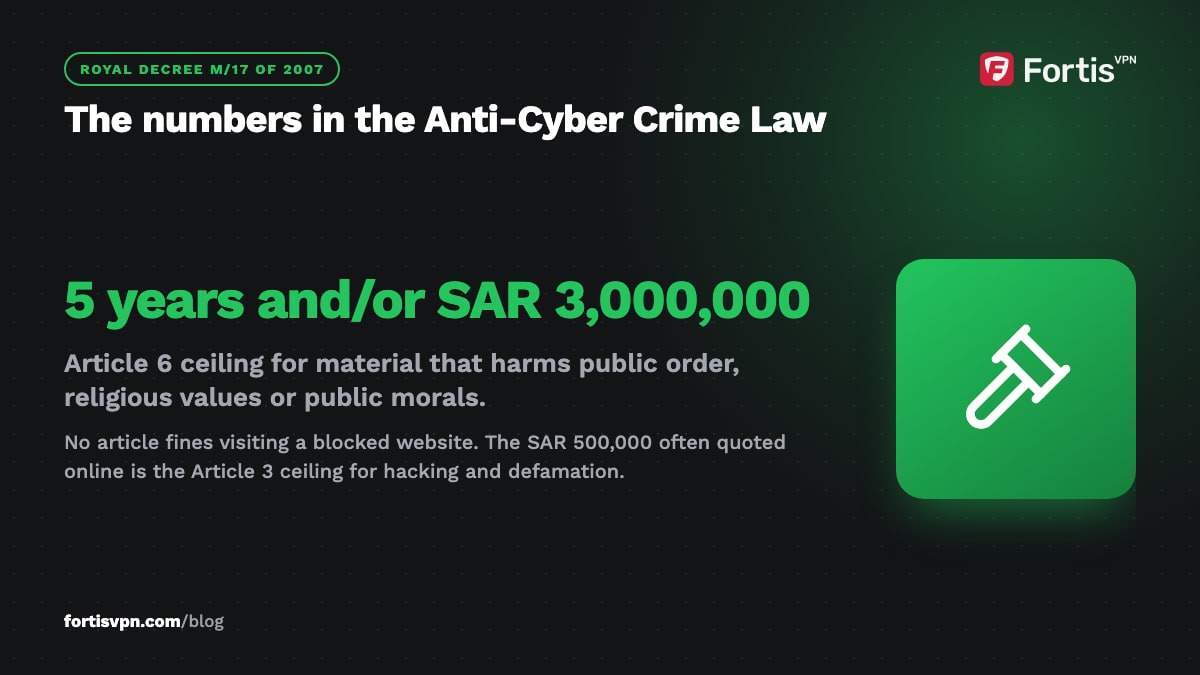
- The Anti-Cyber Crime Law sets fines up to SAR 3 million and 5 years in prison for prohibited content.
- Some VPN websites and apps are blocked at times; business VPNs are approved by the regulator.
- Internet calling in some apps is restricted; the WhatsApp calling situation is unclear in 2026.
What Saudi law says (and does not say) about VPNs
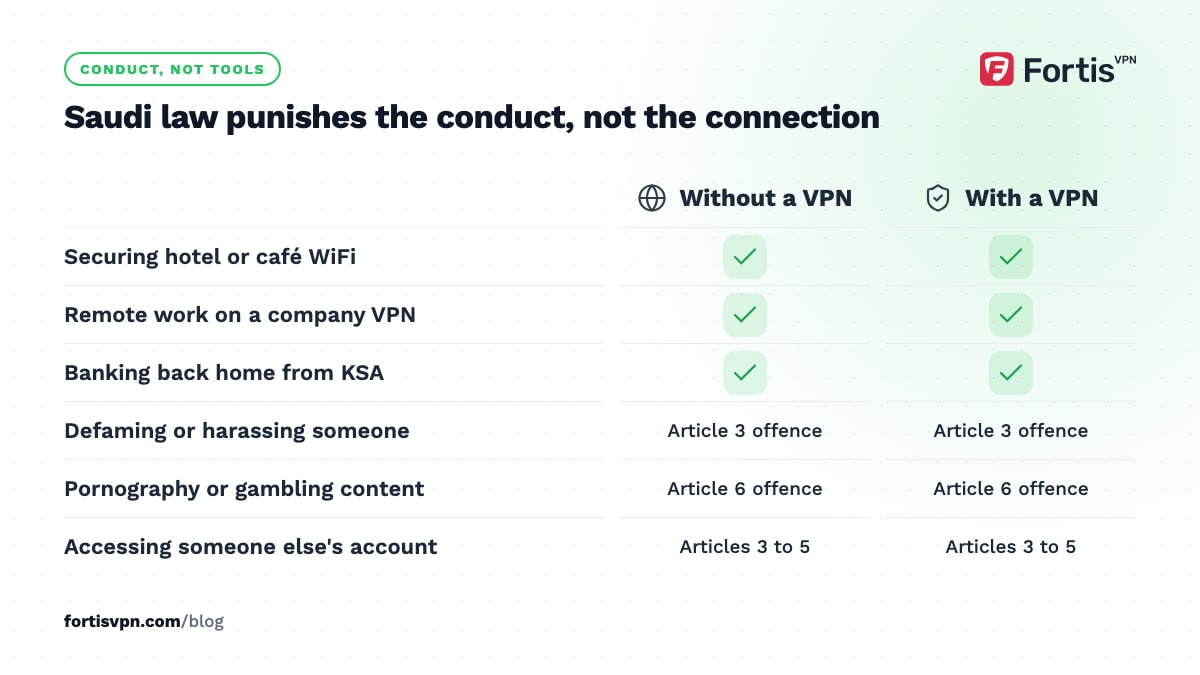
The main statute is the Anti-Cyber Crime Law, issued by Royal Decree No. M/17 on 26 March 2007. The Ministry of Communications and Information Technology publishes an official English translation. Read it end to end and you will not find the words "VPN", "proxy" or "blocked website". The law is about conduct, not tools.
The articles that matter for VPN users are the content and access offences:
| Article | What it covers | Maximum penalty |
|---|---|---|
| Article 3 | Intercepting data, unlawful access to blackmail someone, hacking a website, camera-phone privacy invasion, defamation | 1 year in prison and/or SAR 500,000 |
| Article 6 | Producing, sending or storing material that harms public order, religious values, public morals or privacy; pornographic or gambling material; sites promoting human trafficking or drugs | 5 years in prison and/or SAR 3,000,000 |
| Article 7 | Sites supporting terrorism; unauthorised access to systems holding state security data | 10 years in prison and/or SAR 5,000,000 |
Nothing in those articles turns on how you connected. A person who posts prohibited content over a plain mobile connection and a person who posts it through a VPN face the same Article 6 charge.
One warning about numbers you will see elsewhere. Several expat and VPN blogs claim a specific fine "for accessing blocked websites", quoting figures such as SAR 500,000 or SAR 1 million plus a year in prison. Those figures do not appear in the statute as a penalty for visiting a blocked page. SAR 500,000 is the Article 3 ceiling for hacking, interception and defamation offences. Treat any guide that cites a "blocked website article" without quoting it with caution.
Legal everyday uses of a VPN in Saudi Arabia
Because the law targets conduct, ordinary security and privacy uses are lawful:
- Encrypting your traffic on hotel, airport, mall and café WiFi.
- Remote work. The regulator, the Communications, Space and Technology Commission (CST), has itself approved operators to sell VPN services to companies for their staff, which tells you VPN technology is treated as a normal business tool.
- Banking and government logins from your home country while you are in the Kingdom, on a server in that country.
- Keeping advertisers and trackers from profiling you by IP address.
- Lawful streaming and gaming on a more stable route.
The same principle runs through our general guide to VPN legality: if an activity is legal without a VPN, the VPN does not change that.
What can get you in trouble
The risk is the content, not the tunnel. Saudi Arabia filters the internet at a national level, and the material behind those filters is often exactly what Article 6 describes. Using a VPN to reach pornography, gambling, or content that insults religion or public order does not make that content legal; it makes you a person committing an Article 6 offence who also happens to be using a VPN.
Other conduct that creates risk whatever tool you use:
- Defaming or harassing someone online (Article 3).
- Posting content the authorities consider a threat to public order or religious values (Article 6).
- Accessing someone else's accounts or systems without permission (Articles 3 to 5).
- Running or promoting an unlicensed telecom service.
Enforcement reports in Saudi Arabia overwhelmingly concern what people published or accessed, not the fact that a VPN was installed. There is no official statement or published case that punishes VPN use on its own, as far as public sources show.
Are VPN apps and websites blocked in Saudi Arabia?
Sometimes. The CST operates the national filtering system, and the websites of some VPN providers, as well as some circumvention tools, have been blocked or disrupted at various times. There is no published list, no announcement when a site is added, and the situation changes. Apps already installed on your phone usually keep working even when the provider's website is blocked, because the app connects directly to server addresses rather than to the website.
What you may notice in practice:
- A VPN provider's website fails to load on a Saudi connection while the app connects normally.
- Standard protocols such as WireGuard or OpenVPN UDP connect on home broadband but struggle on some mobile or corporate networks.
- Hotel and office WiFi filters VPN traffic as local policy.
Protocol options exist for these cases. OpenVPN TCP on port 443 looks like ordinary HTTPS traffic, and obfuscated servers go a step further. They keep a lawful connection working; they do not change what is lawful to do over it.
WhatsApp and VoIP calls in Saudi Arabia
Internet calling has a long history in the Kingdom. The regulator began blocking VoIP apps in 2013. In September 2017 it lifted the ban for apps that met its regulatory requirements, and calling returned in several apps, but WhatsApp calling stayed blocked. In March 2024 the CST publicly denied rumours that WhatsApp calls had been unblocked.
In February 2025, Gulf News reported that many users found WhatsApp voice and video calls working, with no official confirmation of whether the change was permanent. As of October 2026 there is still no clear CST statement, and users report different experiences on different networks. The honest answer is: check on your own connection, and ask your operator.
Whatever the status, the rule for VPN users is the same as in the UAE and Qatar: a VPN does not make a restricted calling service licensed. Use services that your operator supports for calls.
Advice for residents, expats, pilgrims and tourists
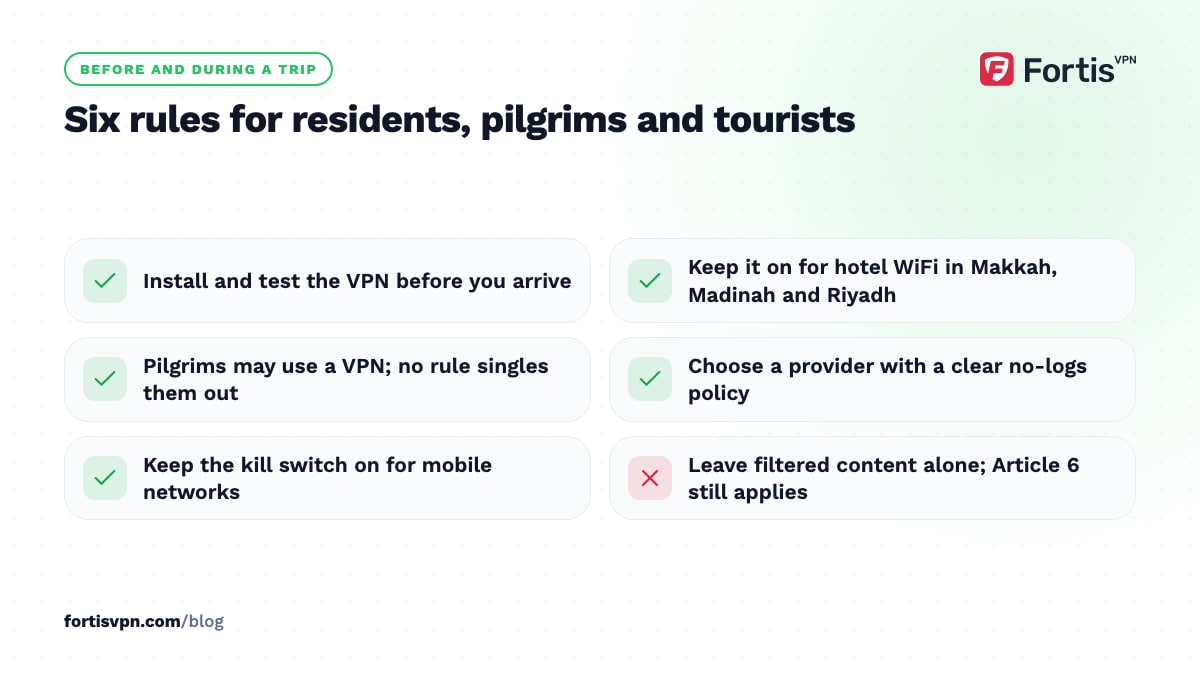
- Install before you arrive. Provider websites may be blocked; Google Play listings and installed apps generally are not. Set up your VPN at home, then test it on arrival.
- Use it for security, not for prohibited content. Hotel WiFi in Makkah, Madinah, Riyadh and Jeddah is public WiFi like anywhere else. Encrypt your banking and messaging; leave filtered content alone.
- Pilgrims: a VPN is fine. Using one during Hajj or Umrah is lawful and useful for reaching your home bank, airline and family services. No rule singles out pilgrims.
- Choose a no-logs provider. Your VPN can see what your ISP would otherwise see, so pick one with a clear no-logs policy.
- Keep the kill switch on. If the tunnel drops on a mobile network, you do not want your traffic falling back to the open connection.
- Know the neighbourhood. Rules differ across the Gulf. See our guides for the UAE and Qatar, and the VPN laws by country table.
This article is general information, not legal advice. For a specific situation in Saudi Arabia, consult a licensed lawyer.
Using FortisVPN in Saudi Arabia
FortisVPN runs on Windows, Android, Android TV, Google TV and Fire TV, and one account covers up to 10 devices, which suits a family or a group travelling for Umrah. The apps keep no activity or connection logs. If a Saudi mobile network interferes with WireGuard, open Settings and switch to OpenVPN TCP on port 443; the Android protocol guide shows the steps. Servers in 100+ countries mean you can reach your home bank from a server in your own country. Plans come with a 7-day free trial and a 30-day money-back guarantee, so start a free trial before you travel and confirm it works on your network. Get the Android app from the Android page.
Frequently asked questions
Can I get fined for using a VPN in Saudi Arabia?
Not for using one. The Anti-Cyber Crime Law contains no penalty for installing or running a VPN. Fines and prison terms in that law attach to conduct such as hacking, defamation, or producing and sharing prohibited material. If you commit one of those offences through a VPN, you are charged for the offence, not for the VPN.
Is a VPN allowed for banking in KSA?
Yes. Encrypting a banking session on public WiFi is a normal security step, and Saudi banks and companies use VPN technology themselves. Connect to a server in the country where your account is held so the bank does not treat the login as suspicious, and keep the kill switch enabled so a dropped tunnel never exposes the session.
Does WhatsApp calling work in Saudi Arabia?
It is unclear as of October 2026. WhatsApp calling was blocked for years, the regulator denied an unblock in March 2024, and in February 2025 users reported calls working without official confirmation. Experiences differ by network. Test on your own connection and ask your operator. A VPN does not change whether a calling service is licensed.
Are VPN websites blocked in Saudi Arabia?
Some are, some of the time. The national filter has blocked the websites of various VPN providers and circumvention tools, with no public list and no notice. Installed apps usually keep connecting because they talk to server addresses rather than the website. Setting up your VPN before you arrive avoids the problem.
Can I use a VPN during Hajj or Umrah?
Yes. Pilgrims may use a VPN for the same lawful purposes as anyone else: securing hotel and mosque-area WiFi, reaching home-country banking, and keeping personal data private. There are no special rules for pilgrims. Install and test the app before you leave home, since VPN provider websites may not load once you are in the Kingdom.
Last updated: 12 October 2026