Is VPN Legal in Turkey? Laws, Blocks, and What Works
Is VPN legal in Turkey? Yes. No law bans VPN use, but the BTK blocks VPN sites and social media at times. What is blocked and what works, October 2026.
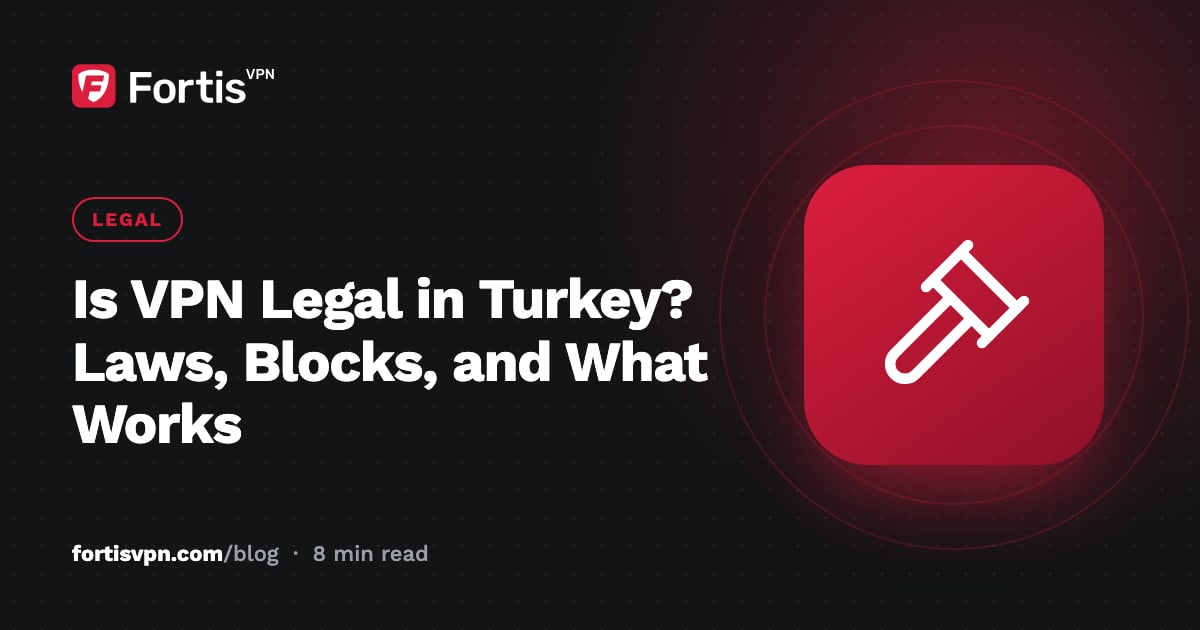
Yes, using a VPN in Turkey is legal. No Turkish law makes it an offence to install or use a VPN, and there is no penalty for individuals. What Turkey does is block access to things: social media platforms during sensitive periods, hundreds of thousands of websites under Law No. 5651, and since late 2023 the websites and server addresses of a list of VPN services. Using a VPN to commit a crime is punished as that crime.
- VPN use is legal in Turkey for individuals; there is no penalty for having or using one.
- The regulator BTK ordered ISPs to block 16 VPN services in late 2023, with court challenges still running.
- Instagram, X, YouTube, TikTok, Discord and Wikipedia have all been blocked or throttled in recent years.
- VPNs still work for most people; protocol choice matters on some mobile networks.
What Turkish law says about VPNs
Turkey's internet law is Law No. 5651 of 2007 on Regulating Broadcasts via the Internet and Combating Crimes Committed through Such Broadcasts. It governs how websites get blocked, who can order a block, and what access providers must do. It contains no offence of using a VPN, and the Turkish Penal Code has none either. Freedom House's annual Freedom on the Net assessment of Turkey records heavy content blocking but no penalties for individuals using circumvention tools.
Two provisions of Law 5651 explain everything that happens to VPNs in Turkey:
- Article 6(1)(ç), added in 2014, obliges access providers to take "alternative access prevention" measures for content that has been blocked. The regulator, the Information and Communication Technologies Authority (BTK), relies on this to ask ISPs to block VPN services that could reach blocked sites.
- Article 8A, added in 2015, lets the BTK block content without a court order on grounds such as national security or public order, with a court asked to confirm afterwards. This is the power behind the sudden platform blocks.
In March 2025 parliament also passed a Cyber Security Law (No. 7545) that rights groups criticised for vague offences around online content and data. It does not criminalise VPN use.
The basic rule from our general guide to VPN legality applies: what is legal without a VPN is legal with one, and what is a crime without a VPN is still a crime with one.
Why Turkey blocks VPN websites and services
The BTK's stated aim is not to stop VPN use. It is to stop VPNs being used to reach websites that are already blocked in Turkey, mainly news sites. On 23 November 2023 the BTK sent access providers a circular letter, citing Article 6(1)(ç), listing 16 VPN services and asking that they be blocked, monitored and reported on monthly. The block was publicly reported in December 2023. The digital rights group İFÖD, whose EngelliWeb report tracks every blocking decision, identified 26 VPN services and 454 server addresses under blocking or monitoring by the end of 2023.
İFÖD sued, arguing that Article 6(1)(ç) gives the BTK no power to pick out VPN services. The Ankara 17th Administrative Court dismissed the case in October 2024; in December 2025 a regional court set that ruling aside on jurisdiction grounds and sent the case to the Council of State, where it is still pending as of October 2026. A 2026 draft amendment to the electronic communications law (No. 5809) would give the BTK explicit VPN powers, but it had not been enacted when this article was last updated.
What "blocked" means in practice:
- The provider's website does not load on Turkish connections, so you cannot sign up or download from it.
- Specific server IP addresses are blocked, so some locations in the app fail while others connect.
- The app itself is not removed from Google Play, and using it is not an offence.
Social media and news blocks in Turkey
Platform blocks are the reason most people in Turkey reach for a VPN. The recent record:
| When | What was blocked | How long |
|---|---|---|
| November 2016 | Social media throttled; BTK reportedly ordered ISPs to block Tor and several VPN services | Days |
| April 2017 to January 2020 | Wikipedia, over two articles the government wanted removed | Nearly 3 years, lifted after a Constitutional Court ruling |
| July 2024 | Internet throttled in Kayseri province during unrest | About a week |
| 2 to 10 August 2024 | Instagram, nationwide, after a dispute over removed posts | 9 days |
| 9 October 2024 | Discord, by court order citing abuse complaints | Long-term |
| 19 to 21 March 2025 | X, YouTube, Instagram and TikTok throttled after the detention of Istanbul's mayor | 42 hours |
Alongside these, Turkish courts and the BTK block tens of thousands of individual URLs each year, including news articles and entire outlets. The EngelliWeb project documents them.
Legal and risky uses
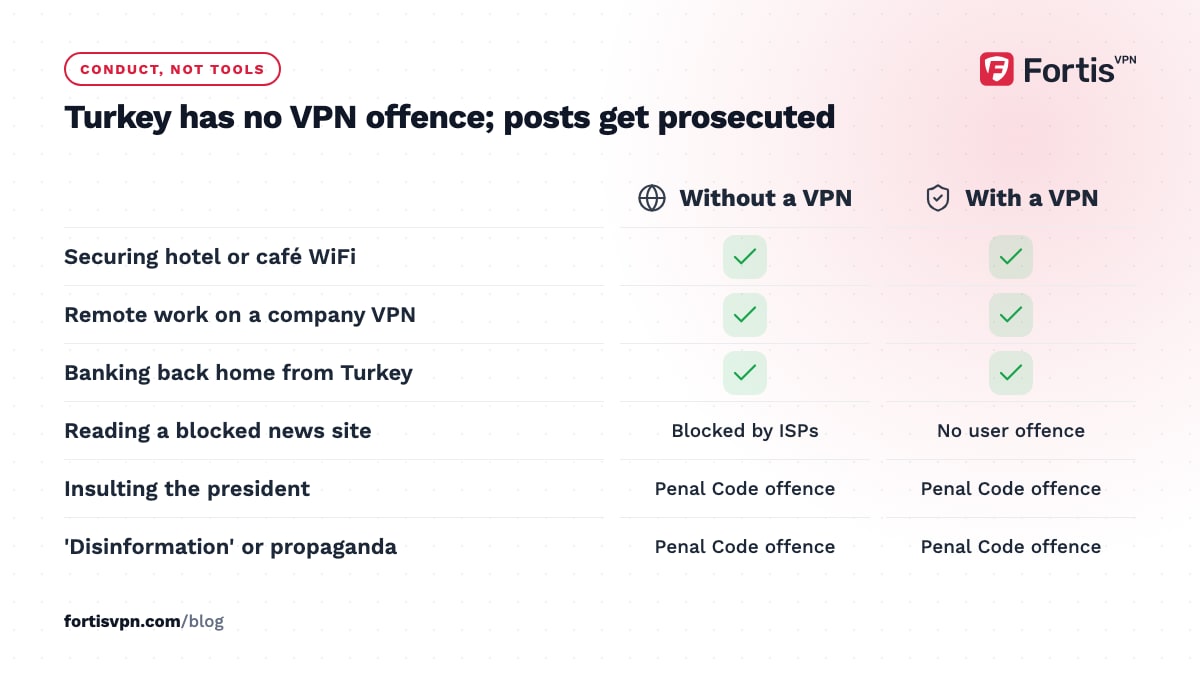
Lawful uses: encrypting traffic on hotel and café WiFi, working remotely over a company VPN, reaching your home bank from Turkey, keeping trackers off your IP, and staying connected to platforms you normally use during a throttling period. Turkish banks, exporters and tech firms run VPNs every day.
Risky uses are the ones where the underlying act is an offence. Turkish law punishes insulting the president, spreading content classed as terrorist propaganda, defamation, and "disinformation" under a 2022 amendment to the Penal Code. A VPN hides your IP from a website; it does not stop a prosecution over a post made under your own name. Accessing a blocked news site through a VPN is not itself an offence under Law 5651, which penalises providers who fail to block, not readers.
Do VPNs still work in Turkey?
For most people, yes, with caveats:
- Fixed broadband connections generally pass standard protocols such as WireGuard and OpenVPN.
- Some mobile networks interfere with VPN traffic, particularly during platform blocks, so a protocol that connects at home may stall on 4G or 5G.
- Blocked providers have specific servers blacklisted; switching to another location in the app usually finds one that works.
- Sign-up and download may fail on Turkish connections if the provider's website is on the block list.
The practical fixes are protocol changes. OpenVPN TCP on port 443 looks like ordinary HTTPS traffic, and obfuscated servers disguise the VPN handshake too. Our protocol guide explains the trade-offs, and the blocked network troubleshooting page gives the order to try them in. It varies by operator and by week, so keep two options ready.
Advice for residents and tourists
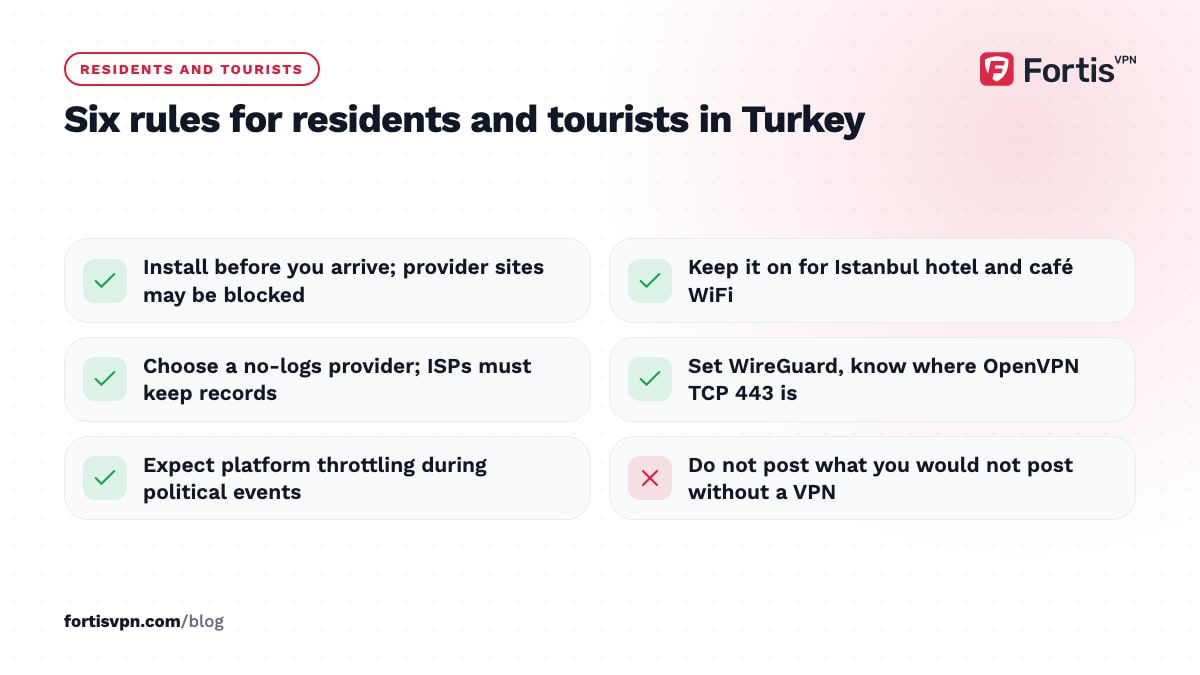
- Install before you arrive. Provider websites may be blocked; the app on Google Play and the Windows installer you already downloaded will work.
- Keep it on for security. Istanbul hotel and café WiFi is public WiFi. A VPN protects your banking and email there like anywhere else.
- Pick a no-logs provider. Law 5651 obliges Turkish ISPs to keep traffic records; a VPN with a genuine no-logs policy has nothing equivalent.
- Keep a fallback protocol. Set WireGuard for speed and know where the OpenVPN TCP 443 switch is for the days it stalls.
- Do not post what you would not post without a VPN. The legal exposure in Turkey is about content, not tools.
- Compare neighbours. The rules in Egypt and across the Gulf differ; the VPN laws by country table lines them up.
This article is general information, not legal advice. For a specific situation in Turkey, consult a licensed lawyer.
Using FortisVPN in Turkey
FortisVPN's apps for Windows, Android, Android TV, Google TV and Fire TV all let you change protocol under Settings, which is the setting that matters most in Turkey. Start on Auto or WireGuard; if a Turkish mobile network stalls the connection, switch to OpenVPN TCP on port 443, as shown in the change protocol guide. If one server location fails, pick another from the 100+ countries on the server list. The apps keep no activity or connection logs, one account covers 10 devices, and the Windows kill switch stops traffic leaking when a connection drops. Every plan has a 7-day free trial and a 30-day money-back guarantee, so start a free trial and test it on your own network.
Frequently asked questions
Is using a VPN in Turkey a crime?
No. Neither Law 5651 nor the Turkish Penal Code contains an offence of using a VPN, and there is no fine for individuals. The BTK blocks some VPN providers' websites and servers to stop them being used to reach blocked content, but that is an order to ISPs, not a rule against users. Crimes committed through a VPN are prosecuted as those crimes.
Why are VPN websites blocked in Turkey?
Because the BTK uses Article 6(1)(ç) of Law 5651, which requires ISPs to prevent "alternative access" to blocked content, to target VPNs that can reach blocked news sites. In late 2023 it listed 16 services; İFÖD identified 26 services and 454 server addresses affected. Court challenges to the BTK's power to do this are still pending as of October 2026.
Can I use a VPN for banking in Turkey?
Yes. Turkish banks use VPN technology themselves and nothing stops you encrypting your banking session on public WiFi. Connect to a server in the country where your account is held so the bank does not flag a foreign login, keep the kill switch on, and use split tunnelling if a local app insists on seeing a Turkish IP.
Does a VPN work on Turkish mobile networks?
Usually, but mobile networks are where interference shows up first, especially during platform blocks. If WireGuard or OpenVPN UDP stalls on 4G or 5G, switch to OpenVPN TCP on port 443 or an obfuscated server. Fixed broadband is generally less affected. Keep two protocol options ready and test them before you need them.
Can tourists use a VPN in Istanbul?
Yes. Visitors can install and use a VPN for the same lawful purposes as residents, and there is no rule against it. Install the app before you fly in case the provider's website is on the block list, use it for hotel WiFi security and home banking, and expect occasional platform throttling during political events. Turkish law applies to what you post, not to the VPN.
Last updated: 1 October 2026