Is VPN Legal in the UAE? What the Law Actually Says
Is VPN legal in the UAE? Yes, for lawful use. Decree-Law 34 of 2021 punishes IP masking only when used to commit or hide a crime. Facts as of October 2026.
Yes, using a VPN in the UAE is legal, as long as you use it for lawful purposes. UAE law does not ban VPN apps. What it punishes is using a VPN, proxy or any other method of hiding your IP address to commit a crime or to cover one up. That offence sits in Article 10 of Federal Decree-Law No. 34 of 2021, and it carries a fine of AED 500,000 to AED 2,000,000.
- VPN use is legal in the UAE; misuse to commit or hide an offence is not.
- Article 10 penalties: temporary imprisonment and/or a fine of AED 500,000 to AED 2,000,000.
- Internet calling in most consumer apps is restricted by the TDRA, and a VPN does not make it legal.
- Banks, companies and government bodies use VPNs every day; residents and tourists can too.
What does UAE law say about VPNs?
The relevant law is Federal Decree-Law No. 34 of 2021 on Combatting Rumours and Cybercrimes. It came into force on 2 January 2022 and replaced the 2012 cybercrime law. You can read the official English text on the UAE legislation portal.
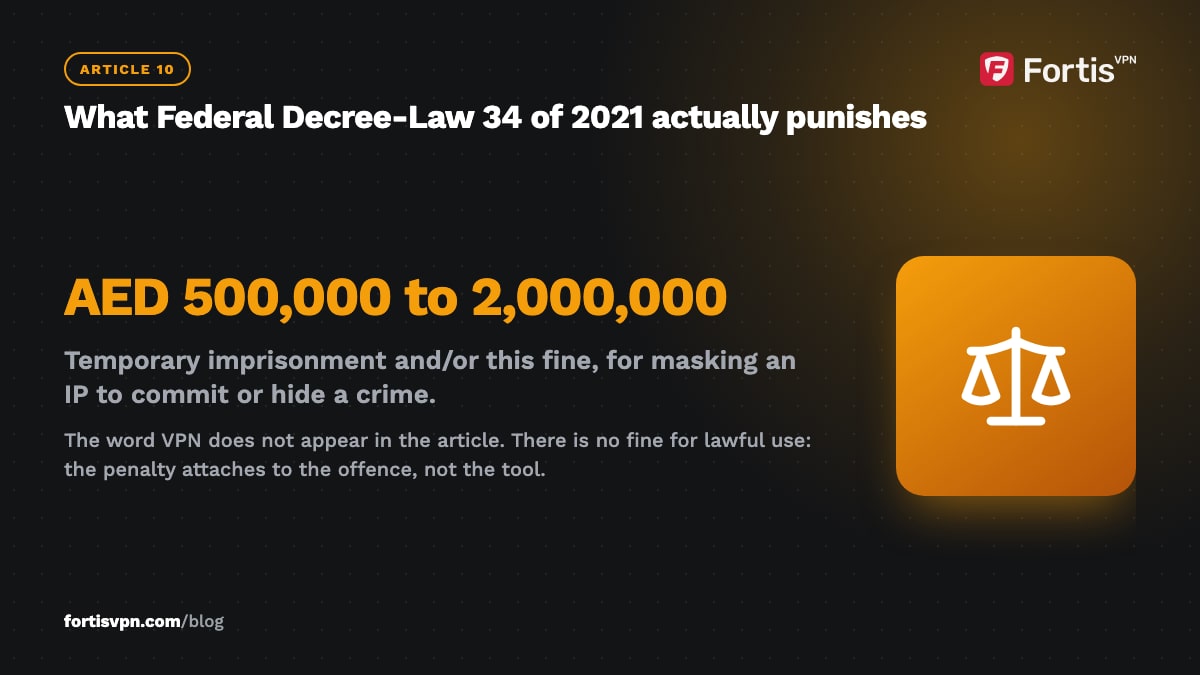
Article 10 is the part people mean when they talk about a "VPN law". In plain English it says: anyone who circumvents a network's IP address, by using someone else's address or by any other means, with the intent to commit a crime or to prevent its discovery, faces temporary imprisonment and/or a fine of between AED 500,000 and AED 2,000,000.
Three things follow from that wording:
- The word "VPN" does not appear. The article covers any technique that masks your IP, including proxies and Tor.
- Intent matters. The offence needs a crime behind it, either one you are committing or one you are hiding.
- The penalty is the same whichever tool you used. The VPN is not the crime; the crime is the crime.
The UAE Public Prosecution has repeated this reading in public awareness posts, including a March 2022 explainer and a December 2024 warning reported by Gulf News: the fine applies to circumvention with the intent of committing a crime or concealing it.
What is legal: everyday VPN use in the UAE
Ordinary privacy and security uses are lawful. Nothing in the decree-law stops you from encrypting your connection. Examples that fall on the safe side:
- Securing your traffic on hotel, mall, airport or café WiFi.
- Connecting to your employer's network for remote work. UAE companies and banks run VPNs for exactly this.
- Stopping advertisers and trackers from profiling you by IP address.
- Logging in to your own bank or government services back home while you travel, where those services are lawful to use.
- Playing games or using cloud services on a more stable route.
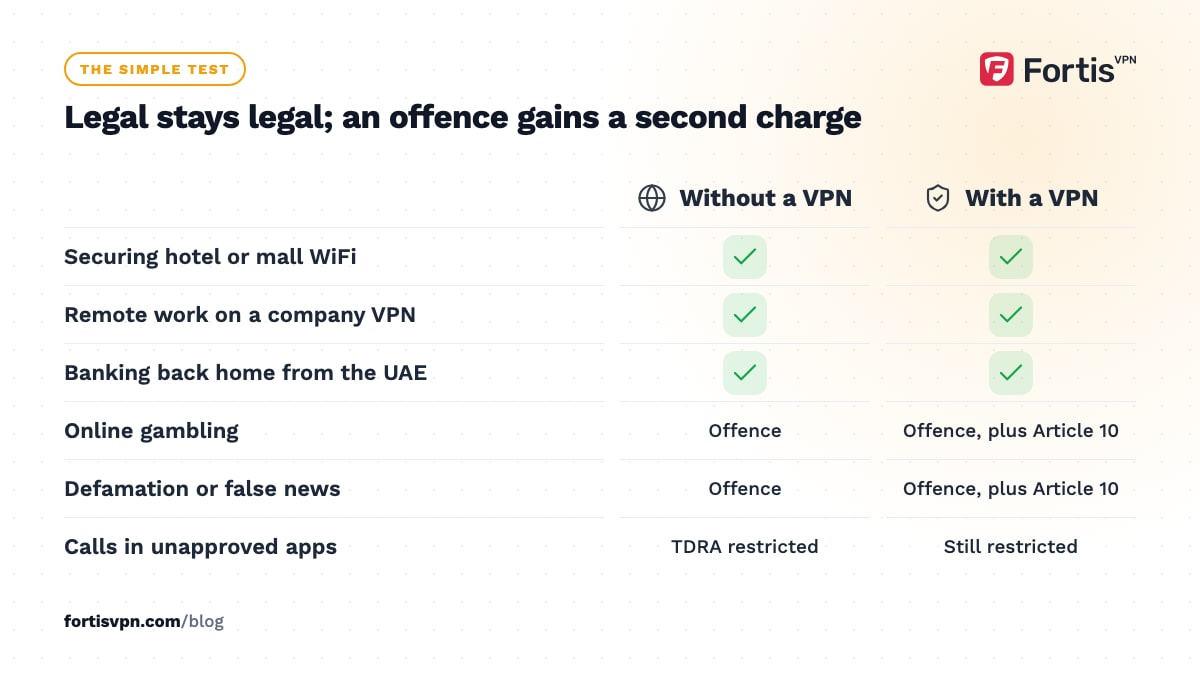
A simple test: if the activity is legal without a VPN, adding a VPN does not make it illegal. The general rules in our guide to VPN legality apply in the UAE as much as anywhere else.
What is illegal: using a VPN to commit an offence
The other half of the test is equally simple: if something is illegal in the UAE without a VPN, it stays illegal with one, and Article 10 adds a second charge on top. The decree-law lists many offences, including:
- Hacking, data theft and electronic fraud.
- Spreading rumours or false news that harm public order.
- Running or promoting online gambling.
- Producing, possessing or sharing pornographic material.
- Insulting religions, defamation and invasion of privacy.
So the realistic risk is not "I have a VPN". It is "I used a VPN to reach a gambling site" or "to post something defamatory while hiding my address". In those cases the VPN can turn one charge into two.
A note on numbers: headlines about a "Dh2 million VPN fine" are technically true but misleading. That ceiling applies only when IP masking is tied to a crime. There is no fine for lawful use.
VoIP apps in the UAE: what the TDRA rules say
Voice and video calling over the internet (VoIP) is regulated separately by the Telecommunications and Digital Government Regulatory Authority (TDRA). Under the TDRA's VoIP policy, calling services may only be offered by the licensed operators, by partners working with them, or by apps the TDRA has approved. The regulator publishes a list of approved apps and says plainly in its FAQ that using unapproved software for calls is very likely illegal, and that operators are obliged to block that traffic.
As of October 2026, calls in several popular messaging apps remain restricted on UAE networks, while text, photo and file messaging in the same apps works normally. The approved list changes, so check the TDRA's current list rather than relying on an old forum post.
The point for VPN users: a VPN does not change the legal status of a restricted calling service. The TDRA rule is about which services are licensed, not about which network path you take. Use an approved app for calls.
Can you be fined for having a VPN app installed?
No. There is no offence of installing, buying or running a VPN app in the UAE. VPN apps are listed openly on Google Play in the UAE, operators sell business VPN services, and the Public Prosecution's own statements target misuse, not possession.
The scale of use tells the same story. Research reported by Khaleej Times in October 2025 put VPN adoption in the UAE at the highest level in the world, with more than 6 million VPN app downloads in the first half of 2025 alone and 9.2 million in 2024. A ban that millions of residents break every day would be enforced very differently.
Do ISPs block VPNs in the UAE?
There is no blanket block on VPN protocols in the UAE as of October 2026. Most VPN apps connect on home broadband and mobile data. What you may run into:
- Some office, school and public WiFi networks filter VPN traffic as policy. That is the network owner's choice, not a law.
- Operators block the traffic of unlicensed VoIP services, as required by the TDRA.
- Websites that are prohibited in the UAE are blocked at ISP level. Reaching them through a VPN is where Article 10 becomes relevant.
If a lawful VPN connection fails on a particular network, the usual fixes are a protocol change such as OpenVPN TCP on port 443, or an obfuscated server, which makes VPN traffic look like ordinary HTTPS. Our VPN blocked on this network page walks through the steps.
Practical advice for residents and tourists
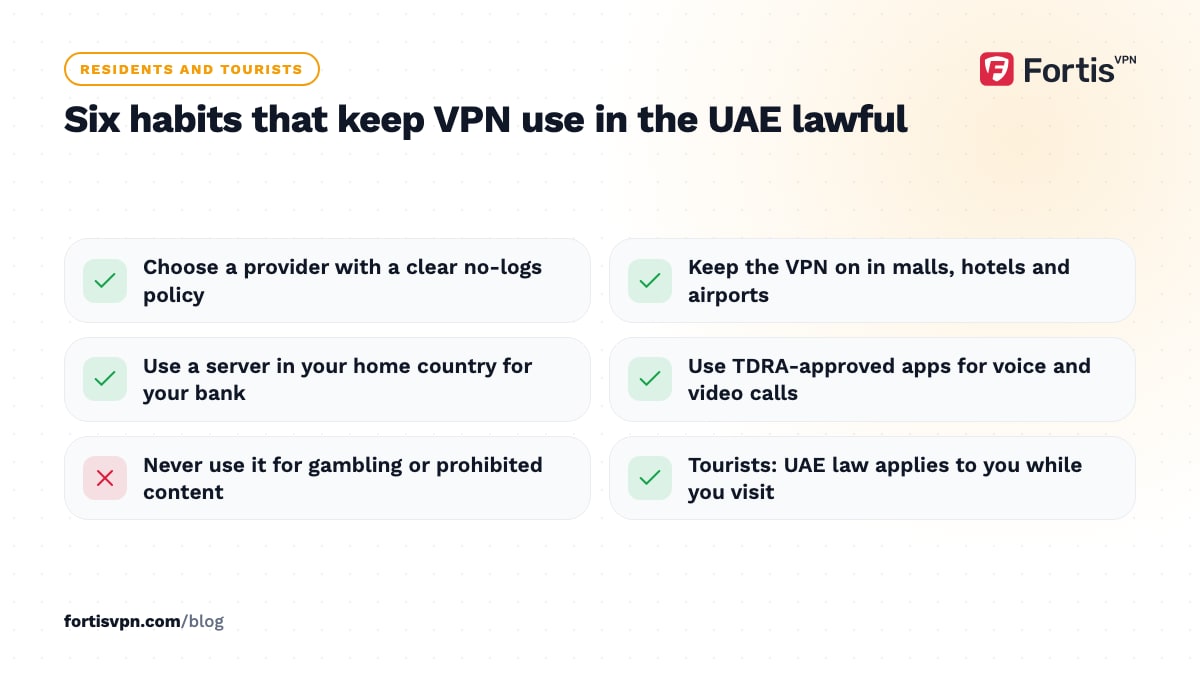
- Pick a reputable provider. A VPN sees your traffic, so choose one with a clear no-logs policy and a real company behind it. Avoid free apps of unknown origin.
- Keep it on for security. On public WiFi in malls, hotels and airports, a VPN is the sensible default.
- Do not use it for anything unlawful. Gambling, prohibited content and unlicensed calling services stay illegal behind a VPN.
- Use approved apps for calls. Check the TDRA list before you rely on an app to phone home.
- Tourists: the same rules apply to you. Visitors are subject to UAE law while in the country. Use your VPN for banking and privacy, nothing more.
- Watch the neighbours. Rules differ across the Gulf. See our guides to Saudi Arabia and Qatar, and the full VPN laws by country table.
This article is general information, not legal advice. If you face a specific legal question in the UAE, speak to a licensed lawyer.
Using FortisVPN in the UAE
FortisVPN works on Windows, Android phones and tablets, Android TV, Google TV and Amazon Fire TV, with one account covering up to 10 devices. Servers in 100+ countries let you reach your home-country banking and services while travelling, and the apps keep no activity or connection logs. If a network blocks standard VPN traffic, switch to OpenVPN TCP on port 443 under Settings; the change protocol guide shows where. The kill switch on Windows stops traffic leaking if the connection drops. Every plan has a 7-day free trial and a 30-day money-back guarantee, so you can start a free trial and test it on your own network before committing.
Frequently asked questions
Is it illegal to use a VPN in Dubai?
No. Dubai follows federal law, and Federal Decree-Law 34 of 2021 does not prohibit VPN use. It penalises using a masked IP address to commit or hide a crime. Using a VPN in Dubai for banking, work, privacy or public WiFi security is lawful. Using it to reach gambling sites or prohibited content is not.
What is the fine for using a VPN in the UAE?
There is no fine for lawful VPN use. Article 10 of the cybercrime law sets a fine of AED 500,000 to AED 2,000,000, with or without temporary imprisonment, for anyone who hides or changes their IP address in order to commit an offence or prevent it being discovered. The fine attaches to the crime, not to the tool.
Can I use a VPN for banking in the UAE?
Yes. Banks themselves run VPNs, and encrypting your banking session on public WiFi is sensible. Two practical tips: connect to a server in the country where your bank account is held so the bank does not flag a foreign login, and turn on the kill switch so a dropped connection never exposes your traffic.
Are VPNs blocked in the UAE?
Not at a national level as of October 2026. VPN apps are available in the UAE and connect on most home and mobile networks. Some workplaces, schools and public hotspots filter VPN traffic as their own policy, and operators are required to block unlicensed internet calling services. Protocol options like OpenVPN TCP 443 help on filtered networks.
Can tourists use a VPN in the UAE?
Yes. Visitors can install and use a VPN for the same lawful purposes as residents: securing hotel WiFi, reaching home banking, and keeping personal data private. The same law applies to tourists, so avoid using a VPN for gambling, prohibited content or unlicensed calling services. Install the app before you fly so you are set up on arrival.
Last updated: 19 October 2026