Does a VPN Work in China? What to Know Before You Travel
Does a VPN work in China in 2026? What the Great Firewall blocks, where the law stands, which protocols and servers help, and how to prepare before you land.

A VPN works in China some of the time, and no VPN works there all of the time. The Great Firewall inspects traffic and blocks known VPN servers, so a connection that works on Monday can fail on Tuesday. Your best odds come from installing before you land, using a protocol that looks like ordinary HTTPS, and keeping a second option ready. Nothing below is a guarantee.
- Google, YouTube, WhatsApp, Instagram, Facebook, X and Wikipedia are all blocked in mainland China.
- Personal VPN use is a legal grey area; the law targets unlicensed providers, and individual fines are rare but real.
- Obfuscated servers, OpenVPN TCP on port 443 and nearby servers raise your chances; nothing guarantees them.
- Install and test everything before you arrive. You cannot download most VPN apps once you are inside.
What does the Great Firewall block?
The Great Firewall is the name given to China's system of internet filtering. It blocks most of the services a traveller relies on at home, and the list has only grown since 2009.
Blocked in mainland China as of October 2026:
- Google Search and most other Google services. Google Play is not offered in mainland China at all.
- YouTube, Facebook, Messenger, Instagram, WhatsApp, Signal and X.
- Wikipedia in every language, Reddit, Discord and Twitch.
- Dropbox, the Steam Community pages, and news sites including the BBC, the New York Times and Bloomberg.
Some services are inconsistent rather than blocked. The Steam store comes and goes. Bing works but redirects to a Chinese version. Zoom works. Netflix is not blocked, but it does not offer service in China, so there is nothing to watch without a VPN.
Hong Kong and Macau sit outside the Great Firewall. Everything above works normally there, with or without a VPN.
Is a VPN legal in China?
Personal VPN use in China is a grey area, not a clear crime. Chinese regulations require international internet connections to go through state-approved channels, and only licensed VPN services, mostly sold to businesses, are officially permitted. Enforcement has focused on people who sell unlicensed VPNs, several of whom have been jailed.
Individuals are rarely punished, but it happens. In a case reported in January 2019, police in Guangdong fined a man 1,000 yuan for using a VPN to reach blocked sites. Reports of foreign tourists being penalised for personal VPN use are hard to find, but the rules apply to everyone in the country.
China's amended Cybersecurity Law took effect on 1 January 2026. It raises penalties for organisations and widens the law's reach, but it does not change the picture for personal use in practice. What does raise your risk is using a VPN to do something that is illegal in China anyway, such as gambling or trading cryptocurrency.
Our guide to VPN laws by country covers the wider region. This article is general information, not legal advice.
Why do most VPNs stop working in China?
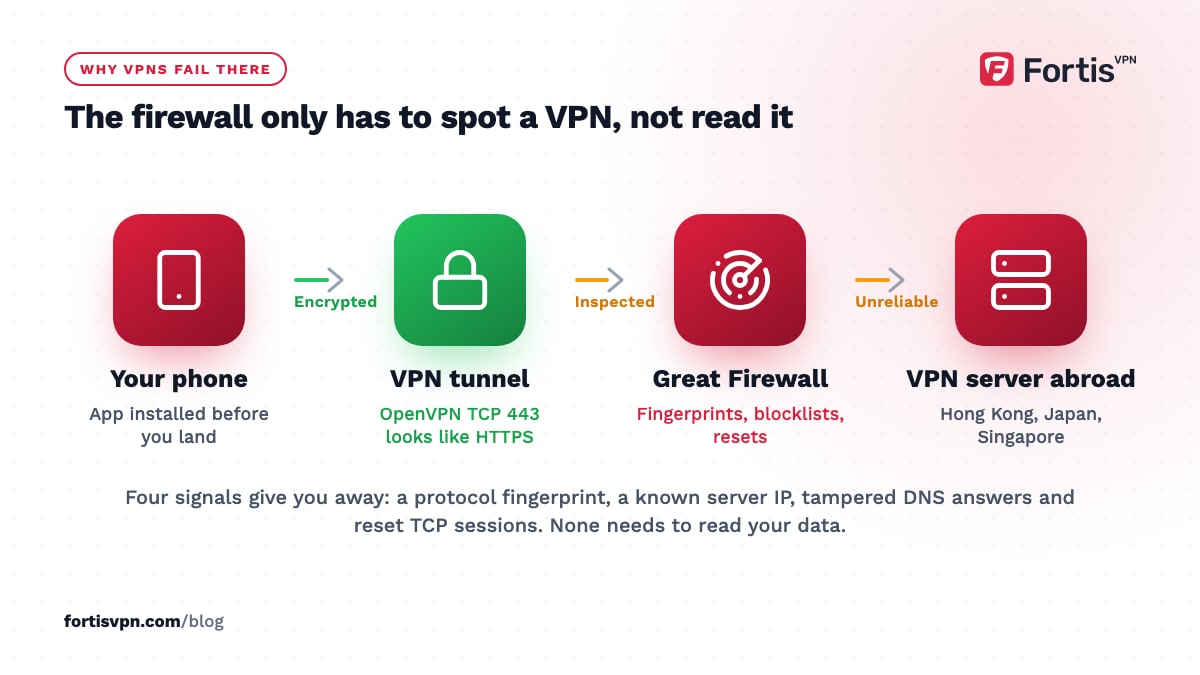
The Great Firewall does not need to know what you are sending. It only needs to recognise that you are using a VPN, and it has four ways to do that.
- Protocol fingerprinting. Deep packet inspection spots the handshake patterns of WireGuard and standard OpenVPN, then drops or throttles the connection.
- IP blocking. VPN server addresses are collected and blacklisted. Popular servers get blocked first.
- DNS tampering. Lookups for blocked domains, including VPN providers' own websites, return wrong answers, so the app cannot even find its servers.
- Connection resets. Suspicious TCP sessions are killed mid-stream, which looks like a VPN that connects and then drops.
Blocking is also not constant. Travellers and expats consistently report that it tightens around major political events and anniversaries, then loosens again. A server that fails today may work next week, which is why you want more than one option.
What helps a VPN work in China?
No setting is reliable on its own. Together, the following give you the best chance.
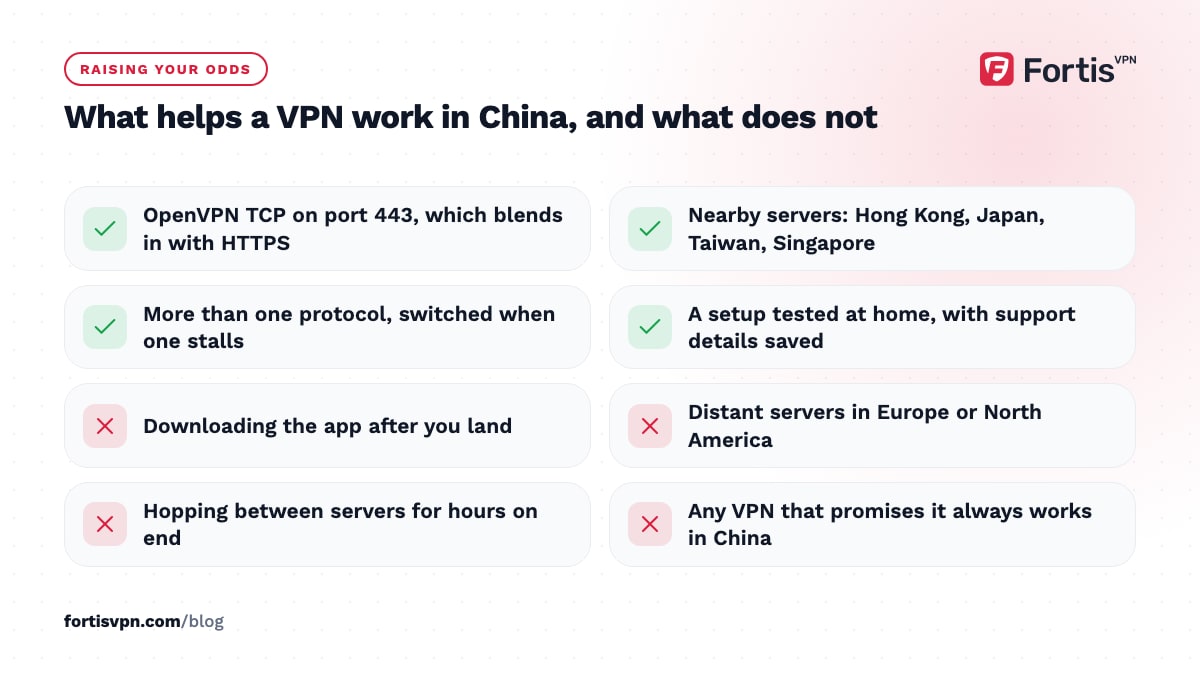
- Obfuscated servers. These wrap VPN traffic so it looks like ordinary web browsing. See what an obfuscated server is and how it differs from a normal one.
- OpenVPN TCP on port 443. Port 443 carries all HTTPS traffic, so blocking it outright would break the web. Routing your VPN through it makes it harder to filter without collateral damage.
- Nearby servers. Hong Kong, Japan, Taiwan, Singapore and South Korea give the shortest route and the least packet loss. Distant servers in Europe or North America are slower and drop more often.
- More than one protocol. If WireGuard is throttled, switch to OpenVPN TCP, then try a different server. Our protocol guide explains what each one changes.
- A tested setup. Connect successfully at home first so you know what a working state looks like. Troubleshooting blind inside China is painful.
Set-up checklist before you travel to China
Do all of this before you board. Once you land, your options narrow fast.
- Install the VPN on every device. Google Play is not available in mainland China, and Apple removed VPN apps from its Chinese storefront in 2017. Install from your home country first.
- Sign in and connect once. Confirm the app shows a connected state and that your IP address changes.
- Find the protocol setting. Locate it in each app now so you can switch to OpenVPN TCP without a guide later. On Windows it is under Settings, as shown in this protocol guide.
- Save your support details offline. If the VPN's website is blocked, you cannot look up its contact page from inside China. Note the email address or the contact page link in advance.
- Pick a backup server list. Write down three or four locations to try in order: Hong Kong, Japan, Singapore, then one further away.
- Sort out the non-VPN essentials. Download offline maps and a translation pack, set up a local payment app, and tell your bank where you are going.
- Add a roaming SIM or eSIM. This is the most reliable backup of all, for reasons explained next.
Does roaming data bypass the Great Firewall?
Often, yes. When you roam on your home carrier's plan, your data is usually routed back through your home network before it reaches the internet. The Great Firewall sits on China's international links, so traffic that exits through a foreign carrier's gateway can reach Google and WhatsApp without a VPN.
This is a side effect of how roaming works, not a feature anyone promises, and it is not guaranteed. Some travel eSIMs use a Chinese partner network and route locally, which puts you back behind the firewall. Check with the provider before you rely on it.
Hotel WiFi and any SIM bought in China are Chinese networks and are filtered like everything else. The strongest combination is a roaming SIM for mobile data, with the VPN handling the hotel and café WiFi you connect to along the way.
What to do if nothing works
Work through this list in order, and give each step a full minute before you judge it.
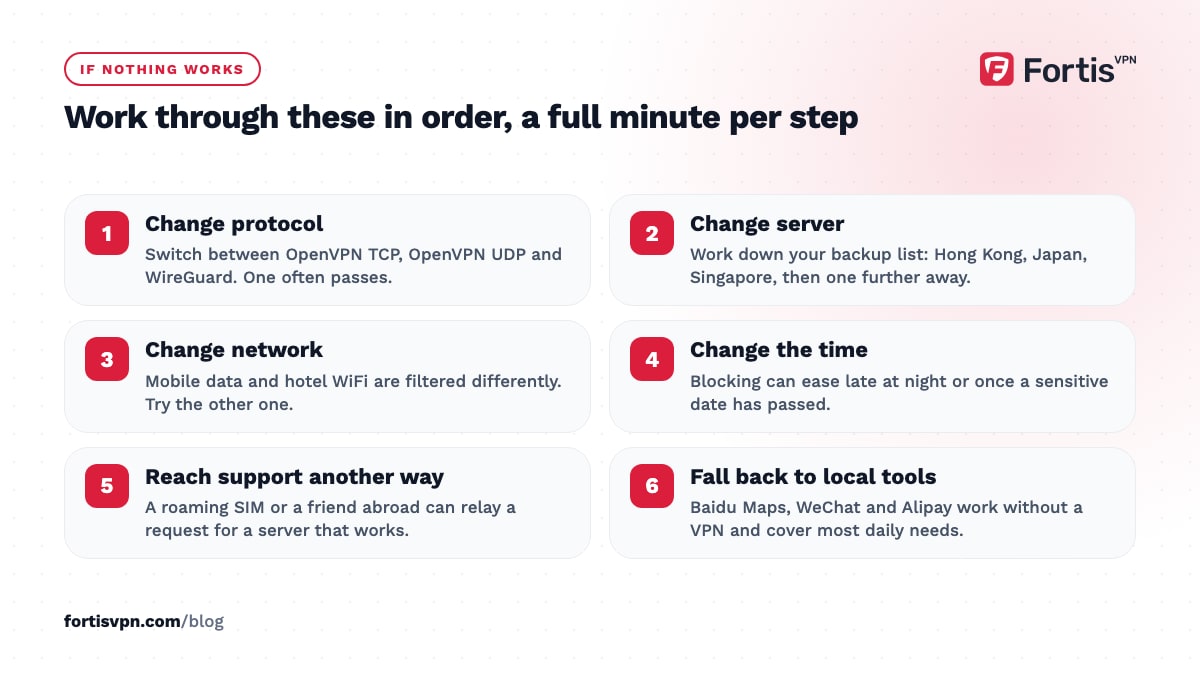
- Change protocol. Switch between OpenVPN TCP, OpenVPN UDP and WireGuard. One is often throttled while another passes.
- Change server. Try each location on your backup list, including an obfuscated one if your provider offers them.
- Change network. Mobile data and hotel WiFi are filtered differently. If one fails, try the other.
- Change the time. Blocking can ease late at night or after a sensitive date passes.
- Contact support from a connection that works. A roaming SIM or a friend abroad can relay a request for a currently working server.
- Fall back to local tools. Baidu Maps, WeChat and Alipay work without a VPN and cover most daily needs.
If none of that helps, accept it for the day. Fighting the firewall for hours rarely beats trying again tomorrow.
Using FortisVPN in China
FortisVPN does not promise to work in China, and you should be wary of any VPN that does. What the apps give you is the set of tools that improve your odds. Every app has OpenVPN TCP on port 443, with WireGuard and OpenVPN UDP as alternatives, and the server list includes Hong Kong, Japan, Taiwan, Singapore and South Korea. Ask support before you fly whether obfuscated servers are available on your plan and which locations to try first.
Timing matters. Start the 7-day free trial at least a week before departure. That leaves time to set up every device and confirm the protocol switch at home. The 30-day money-back guarantee covers you if it does not work out once you arrive.
Frequently asked questions
Can I download a VPN in China?
Usually not. Google Play is not available in mainland China, Apple's Chinese storefront removed VPN apps in 2017, and most VPN providers' websites are blocked, so direct downloads fail too. Install the app, sign in and test it before you travel. If you forget, a roaming SIM may let you reach the download page.
Do tourists get punished for using a VPN in China?
Reported cases are very rare and have involved Chinese residents rather than visitors. The known individual penalties are administrative fines, with 1,000 yuan the figure in the widely reported 2019 case. The risk rises if you use a VPN for something illegal in China itself. Use it for your usual apps and keep a low profile.
Which VPN protocol works in China?
Of the standard protocols, OpenVPN over TCP on port 443 has the best record, because it blends in with normal HTTPS traffic. Obfuscated servers built to hide VPN signatures do better still. WireGuard is fast but has a recognisable fingerprint, so it is often throttled. Keep all three available and switch when one stalls.
Does WhatsApp work in China?
No. WhatsApp has been blocked since September 2017, along with Facebook, Instagram, Signal and most other foreign messaging apps. It works on roaming data from a foreign SIM and through a working VPN. Agree a backup with the people you need to reach, since WeChat is the app nearly everyone in China uses.
Does a VPN work in Hong Kong?
Yes. Hong Kong and Macau are outside the Great Firewall, so Google, WhatsApp and YouTube work there without any help, and a VPN connects as it would anywhere else. Many travellers use Hong Kong as a server location for mainland trips because it is close and well connected.
Last updated: 8 October 2026