Is VPN Legal in Qatar? What You Need to Know
Is VPN legal in Qatar? Yes. Law No. 14 of 2014 does not ban VPNs; it punishes offences committed online. Blocks, VoIP rules and tips as of October 2026.
Yes, using a VPN in Qatar is legal. Qatar's Cybercrime Prevention Law, Law No. 14 of 2014, does not mention VPNs, proxies or circumvention tools, and no other rule bans them. What the law punishes is conduct: publishing false news, breaching social values or someone's private life, hacking, fraud and similar offences, whether or not a VPN was involved. There are two practical catches: internet calling in some apps is restricted, and the websites of some VPN providers are blocked.
- VPN use is legal in Qatar; crimes committed through a VPN are still crimes.
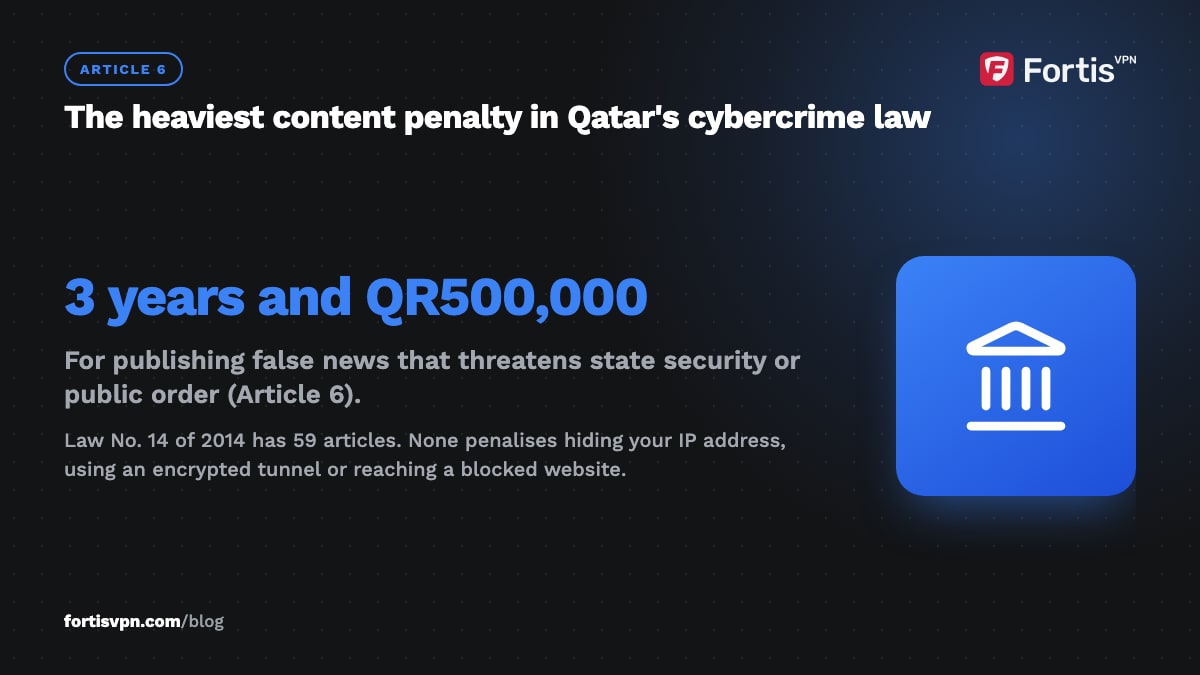
- Law No. 14 of 2014 sets penalties up to 3 years and QR500,000 for false news and content offences.
- Only Ooredoo and Vodafone Qatar may sell voice services; calling in some apps is restricted.
- Install your VPN before arrival, use it for security, and keep away from blocked content.
Qatar's cybercrime law in plain English
Law No. 14 of 2014 Promulgating the Cybercrime Prevention Law is Qatar's main online offences statute. It has 59 articles, took effect in late 2014, and was amended by Law No. 11 of 2025, which added an offence of publishing images or videos of people without their consent. The official text, in Arabic and English, is on the Al Meezan legal portal.
The articles most relevant to someone wondering about VPNs are the content offences and the provider duties:
| Article | What it covers | Maximum penalty |
|---|---|---|
| Article 2 | Unauthorised access to a state body's systems | 3 years and QR500,000 |
| Article 6 | Running a website to publish false news that threatens state security or public order | 3 years and QR500,000; sharing such news, 1 year and QR250,000 |
| Article 8 | Violating social values or principles; publishing material about people's private or family life, even if true; insult and slander | 3 years and QR100,000 |
| Article 9 | Online threats and blackmail | 3 years and QR100,000 |
| Article 21 | Service providers must block links when a judge orders it, keep user information for a year and traffic data for 90 days on request | Provider fine up to QR500,000 (Article 47) |
Notice what is missing. No article penalises hiding your IP address, using an encrypted tunnel, or reaching a blocked website. That is a real difference from the UAE, whose law has a specific IP-masking offence, and it is why the honest answer to "is VPN legal in Qatar" is a plain yes rather than a cautious maybe.
Legal uses of a VPN in Qatar
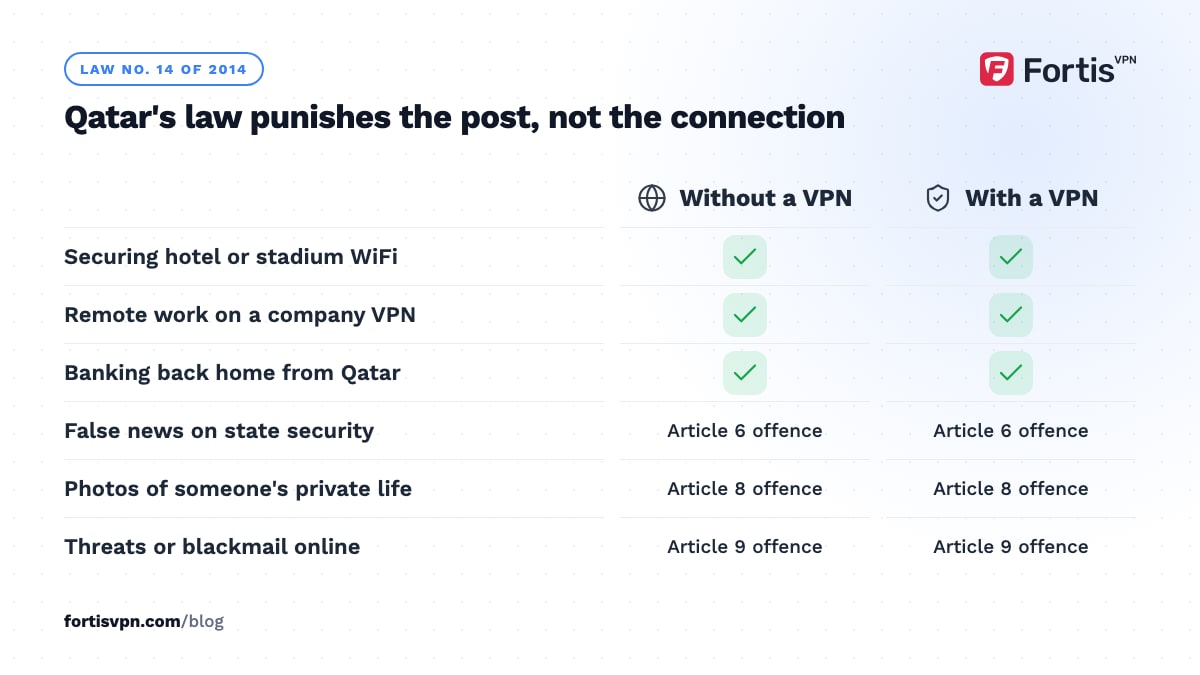
Everyday privacy and security uses are lawful:
- Encrypting your connection on hotel, mall, stadium and café WiFi.
- Remote work over your employer's VPN, which companies across Doha run every day.
- Reaching your own bank, tax office or government portal back home while you are in Qatar.
- Stopping advertisers and data brokers from building a profile around your IP address.
- Gaming and cloud services on a steadier route.
Qatar has one of the highest rates of VPN use in the world; research reported by Gulf newspapers in 2025 placed it second only to the UAE. Reporting from the 2022 FIFA World Cup, when visitors used VPNs widely, concerned calling restrictions and mandatory apps, not VPN prosecutions. Our general guide to VPN legality covers the same principle: lawful without a VPN means lawful with one.
What is illegal, with or without a VPN
A VPN hides your IP address from websites. It does not hide your identity from a court, and it does not change the law. Conduct that is an offence in Qatar remains one behind a VPN:
- Publishing or sharing false news that threatens state security or public order (Article 6).
- Posting content that breaches social values, or photos and recordings of someone's private life (Article 8), including the 2025 offence of sharing images without consent.
- Insulting or defaming people online (Article 8).
- Threats, blackmail, hacking, fraud and forgery (Articles 2 to 5 and 9 to 14).
- Content that is prohibited in Qatar, such as pornography, stays prohibited; reaching it through a VPN removes none of the legal risk.
The last point is where most of the "VPN risk" talk comes from. Qatar filters the internet, and reaching filtered material is not a VPN offence in itself, but the material can be. If what you are viewing or sharing is an offence under Qatari law, the VPN is no defence, and the court may also confiscate the devices used (Article 53).
Are VPNs blocked by Qatari ISPs?
Partly. Ooredoo and Vodafone Qatar apply the national content filter, and that filter has at times included the websites of VPN providers and other circumvention tools. There is no published list. In practice:
- Some VPN providers' websites do not load, while the apps, once installed, connect normally because they use server addresses rather than the website.
- Standard protocols generally work on home fibre and mobile data. Some corporate, campus and hotel networks filter VPN traffic as local policy.
- Internet calling traffic in unlicensed apps is restricted at network level (see below).
If a lawful VPN connection fails on a particular Qatari network, the usual steps are a protocol change to OpenVPN TCP on port 443 or an obfuscated server, both of which make VPN traffic resemble ordinary HTTPS. Our blocked network troubleshooting page lists the full sequence.
VoIP calls in Qatar: WhatsApp, FaceTime and the CRA rules
The Communications Regulatory Authority (CRA) is clear on the law: Qatar has no rule banning VoIP technology, and any person or company may use internet calling for their own calls. What the Telecommunications Law (Law No. 34 of 2006) prohibits is selling telecom services to the public without a licence, and only Ooredoo and Vodafone Qatar hold licences to provide public voice services. The CRA's own VoIP policy sets this out.
In practice, since 2017 voice and video calls in several popular apps have been reported as blocked or degraded on Qatari networks, while messaging in the same apps works. Ooredoo has said call quality in those apps is outside its control, and the CRA has not published a 2025 or 2026 statement changing the position. Expect calling in unlicensed apps to be unreliable, and do not rely on a VPN to fix it: the restriction is about licensing, not about your network path.
Tips for residents and visitors
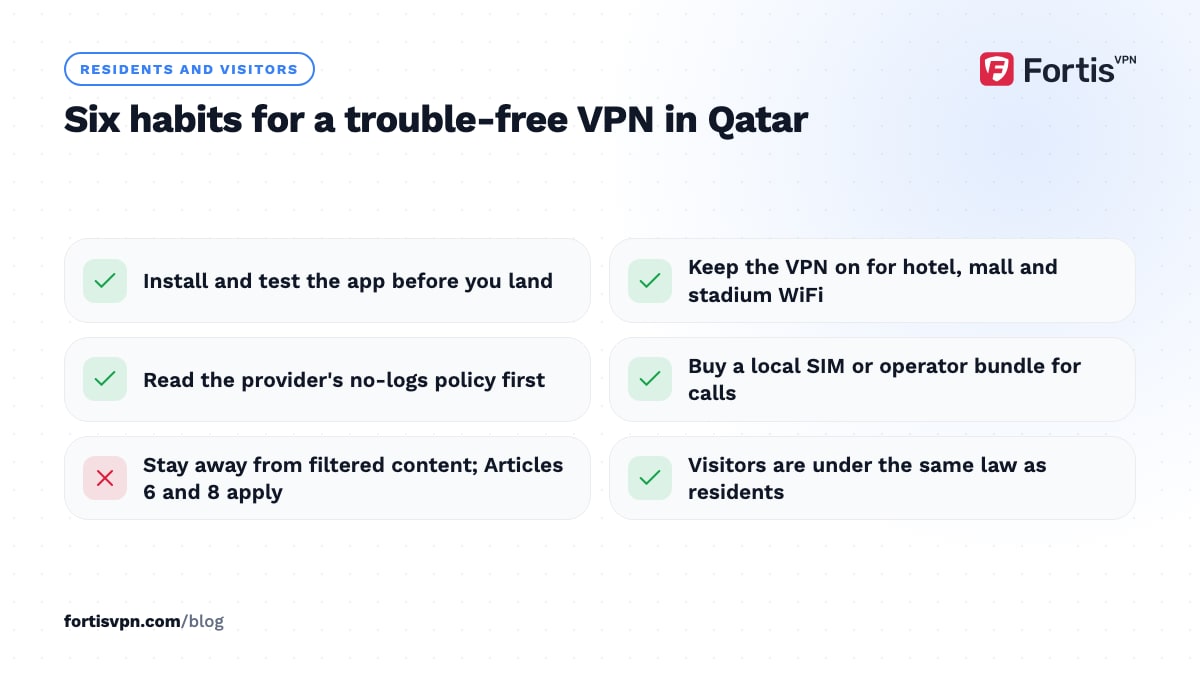
- Install and test before you land. Provider websites may be filtered; an installed app usually is not.
- Use the VPN for security. Hotel, mall and stadium WiFi is public WiFi. Keep the VPN on for banking, email and messaging.
- Stay away from filtered content. The filter marks what Qatar considers prohibited, and Articles 6 and 8 carry real prison terms.
- Pick a no-logs provider. Your VPN sees what your ISP would otherwise see, so read the no-logs policy first.
- Use licensed services for calls. Buy a local SIM or an operator calling bundle rather than depending on app calls.
- Check the neighbours. The UAE has an explicit IP-masking offence and Saudi Arabia blocks more VPN sites; the VPN laws by country table compares them.
This article is general information, not legal advice. For a specific situation in Qatar, consult a licensed lawyer.
Using FortisVPN in Qatar
FortisVPN's apps for Windows, Android, Android TV, Google TV and Fire TV cover a Doha household on one account, with up to 10 devices connected at once. Servers in 100+ countries let you reach your home bank from a server in that country, and the service keeps no activity or connection logs. If a Qatari network interferes with WireGuard, switch to OpenVPN TCP on port 443 under Settings; the protocol guide shows where. Split tunnelling lets local apps such as food delivery skip the VPN while everything else stays encrypted. Every plan has a 7-day free trial and a 30-day money-back guarantee, so start a free trial and test it on your own connection.
Frequently asked questions
Can I use a VPN in Qatar for banking?
Yes. Encrypting a banking session on public WiFi is sensible, and Qatari banks and businesses use VPN technology themselves. Connect to a server in the country where your account is held so the bank does not flag a foreign login, and enable the kill switch so a dropped tunnel never exposes the session to the open network.
Is VPN illegal in Doha?
No. Doha follows national law, and Law No. 14 of 2014 contains no offence of using a VPN, proxy or encrypted tunnel. Residents and visitors in Doha use VPNs for work, banking and privacy without legal issue. The law punishes what you publish or access, so the only risk comes from prohibited content or conduct.
Are FaceTime or WhatsApp calls blocked in Qatar?
Calling in several popular apps has been reported as blocked or degraded on Qatari networks since 2017, while messaging works. The CRA says VoIP technology is not banned; only unlicensed selling of voice services is. As of October 2026 there is no official statement lifting the restriction, so treat app calling as unreliable and use licensed operator services for important calls.
Will Ooredoo or Vodafone Qatar block my VPN?
They may block the provider's website, and they restrict unlicensed calling traffic, but standard VPN connections generally work on their home and mobile networks. If a connection fails, switch protocol to OpenVPN TCP on port 443 or use an obfuscated server, which makes VPN traffic look like regular HTTPS. Install the app before you arrive.
Can tourists use a VPN in Qatar?
Yes. Visitors can install and use a VPN for the same lawful purposes as residents: securing hotel and stadium WiFi, reaching home banking and keeping personal data private. The same law applies to tourists, so avoid prohibited content and conduct. Set up the app before travelling in case the provider's website is filtered locally.
Last updated: 2 October 2026