Are Free VPNs Safe? What a Free VPN Really Costs You
Are free VPNs safe? A few limited free tiers are honest, but many free VPN apps log, leak or carry adware. How they make money and how to spot a safe one.
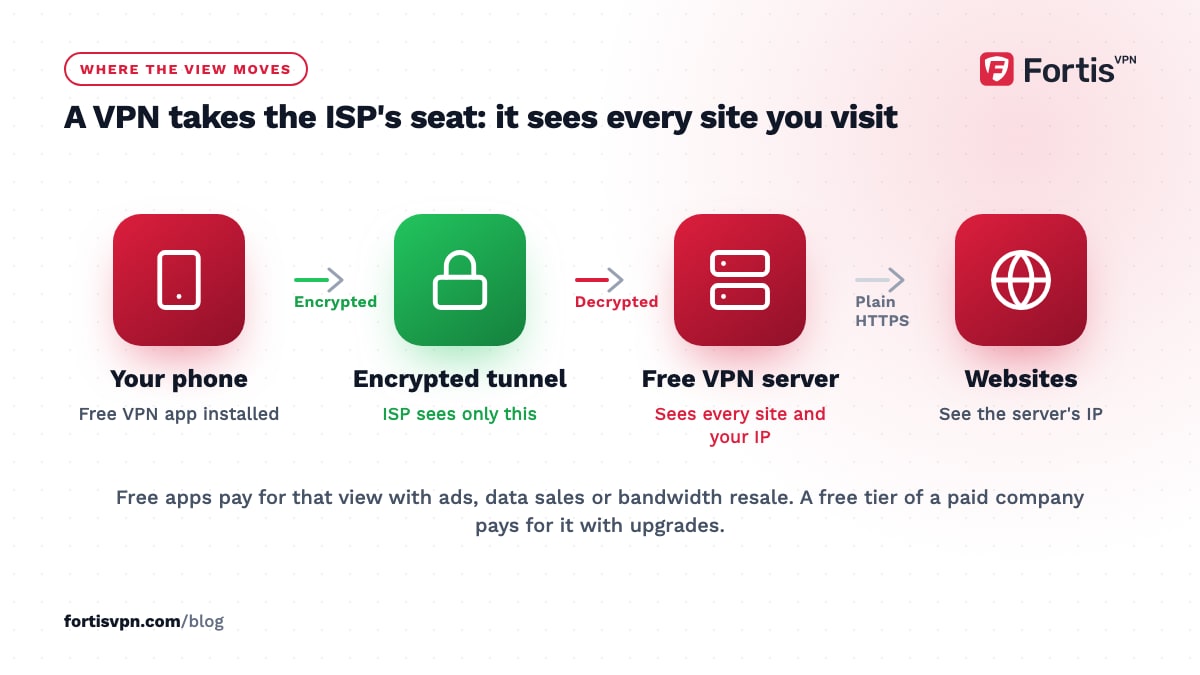
Some free VPNs are safe, most are not, and the difference is how the company pays its bills. A VPN sees every site you visit, the same view your ISP has, so a free VPN that funds itself by selling that data or injecting ads is worse than using no VPN at all. A free tier from a company that sells paid plans can be honest. A standalone free app with no visible income usually is not.
- A VPN provider can see everything your ISP could see, so trust matters more than price.
- Free VPN apps make money from ads, selling browsing data or reselling your bandwidth.
- Studies of free Android VPN apps keep finding malware flags, missing encryption and leaks.
- A free trial of a paid VPN is not a free VPN; it has the paid plan's full protections.
How do free VPNs make money?
Running VPN servers in dozens of countries costs real money every month. A free app with millions of users has to cover that somehow, and there are only a few ways to do it:
- Ads. Banners and video ads inside the app, and sometimes ads injected into the web pages you visit, which a VPN is in a perfect position to do.
- Selling browsing data. Which sites you visit, when, from where and on which device is valuable to data brokers and advertisers. The privacy policy often admits this in careful wording about "partners".
- Reselling your bandwidth. Some free VPNs turn your device into an exit point for other customers, so strangers' traffic leaves through your home connection and your IP address.
- Upselling. A reputable company gives away a slow or capped tier to persuade you to pay. This is the honest model, and the free tier usually gets the same app, policy and encryption as the paid one.
Only the last model has you as the customer. In the other three, you are the product, and the VPN has a direct reason to keep as much of your data as it can.
What are the risks of a free VPN?
The clearest evidence comes from research on Android, where free VPN apps are easiest to study. A 2016 study by Australia's CSIRO and partner universities examined 283 Android apps that requested VPN permissions. Among them, 38% were flagged by at least one antivirus engine for malware or adware, 18% did not encrypt the tunnel at all, and 84% did not tunnel IPv6 traffic, so it travelled outside the VPN. Later analyses by security researchers and consumer groups have kept finding the same patterns in the most-downloaded free VPN apps.
In practice, the risks look like this:
- No real encryption. The app changes your IP but sends your traffic in the clear, so it is a proxy wearing a VPN badge.
- Leaks. DNS requests, IPv6 traffic or WebRTC reveal your real address even while "connected".
- No kill switch. When the tunnel drops, your traffic carries on over the normal connection without warning. See why a kill switch matters.
- Logging and resale. Connection times, sites visited and your real IP, stored and shared.
- Adware and tracking libraries. Third-party trackers bundled into the app that report your activity to advertisers.
- Clone apps. Apps that copy the name and logo of a known VPN to harvest installs, sometimes carrying spyware.
Free tier vs free app: not the same thing
There is a real difference between a free plan and a free product.
A free tier is a paid VPN company giving away a limited version: a monthly data cap, a handful of servers, slower speeds or one device. You get the same app, the same encryption and the same privacy policy as paying customers, because it is the same software. The company's incentive is to convert you, not to sell you.
A free app is a product that is free for everyone, forever, with no paid version or a paid version nobody buys. The company may be a one-person operation, a shell with no address, or a marketing firm. There is no customer to protect, so the incentives point the other way.
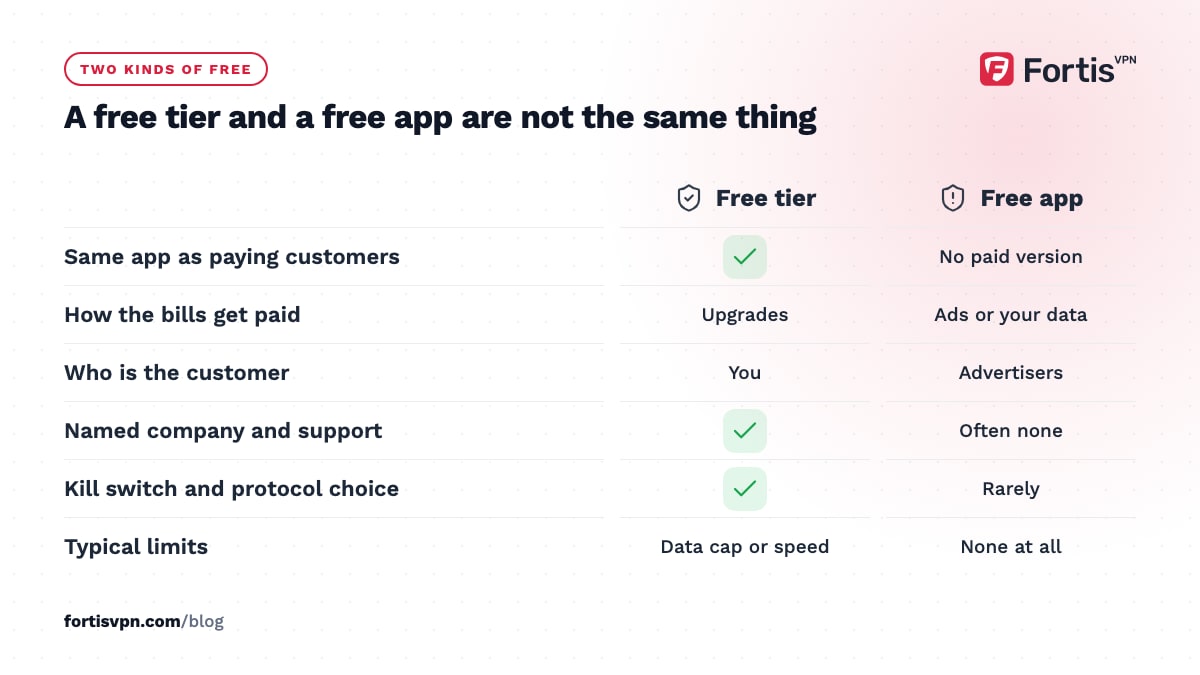
When you are tempted by a free VPN, ask which of these it is. If the company has no paid product and no explanation of how it makes money, assume the answer is your data.
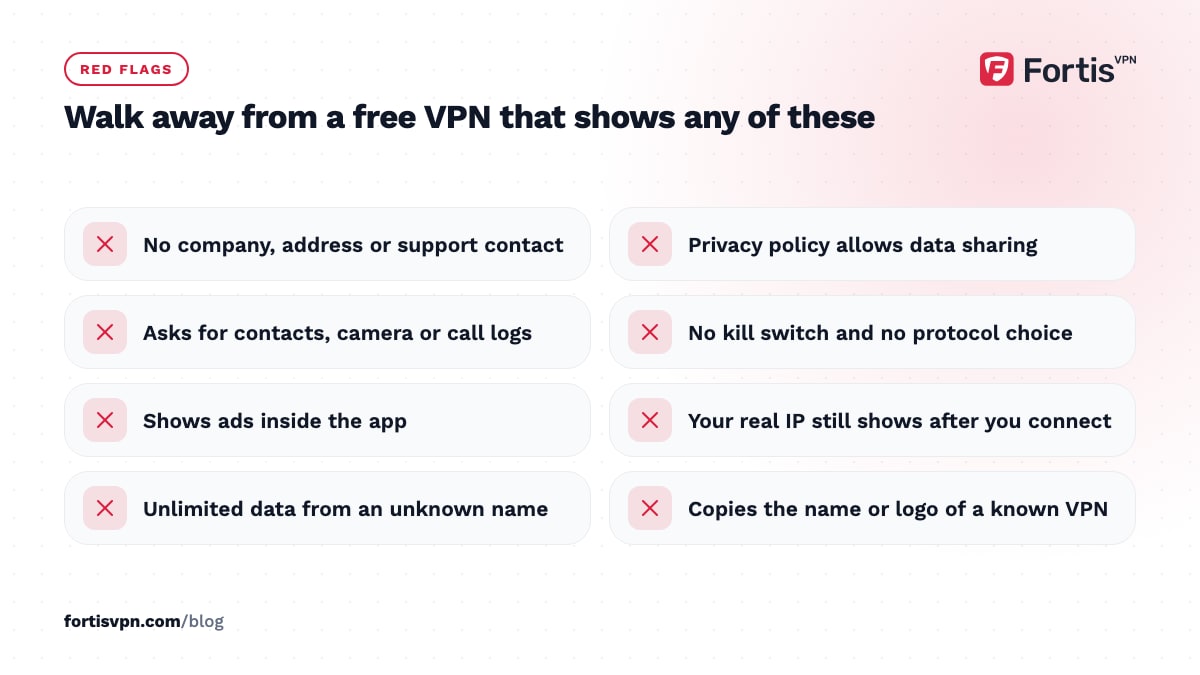
7 signs a free VPN is unsafe
- No company behind it. The listing names an individual or a brand with no website, address or support contact.
- A privacy policy that permits sharing. Look for "partners", "affiliates", "advertising" or "aggregated data". A no-logs policy should say plainly what is not stored; read what a no-logs policy means.
- Permissions beyond a VPN. A VPN needs network access. It does not need your contacts, call logs, camera, location or the ability to read other apps.
- No kill switch and no protocol choice. Serious apps offer both. Their absence usually means the app is a thin wrapper around a proxy.
- Ads inside the app. If the app shows ads, an ad network is receiving data about you, and the app has every reason to send more.
- Your real IP still shows. Connect, then run an IP address check. If it shows your own location or ISP, the app is not doing its job.
- Nothing is limited. Unlimited data, unlimited speed and no account, for free, from a company you have never heard of. Bandwidth is not free, so something else is paying.
When are free VPNs safe to use?
A free VPN is acceptable in a narrow set of cases:
- It is the free tier of a company you would be willing to pay, and you have read its policy.
- You want to reach a website that is blocked on your network, and nothing you do through it involves signing in or paying.
- You are testing whether a VPN solves a problem before you commit to a plan.
Even then, assume the free service logs connections, and never use it for banking, work accounts, email, torrents or anything you would not do in front of your ISP. In a country that restricts VPN use, a free app of unknown origin is the worst possible choice, because its logs are the first thing anyone would ask for.
What a paid VPN gives you that a free one cannot
You are paying for a business model in which the only thing the company sells is the service. That changes everything downstream:
- A no-logs policy the company has a commercial reason to honour, because a single logging scandal ends the business.
- A kill switch, leak protection and a choice of modern protocols such as WireGuard and OpenVPN.
- Servers in many countries, with enough capacity that streaming and downloads work.
- Apps for TVs and other devices, not only a browser extension.
- Support when something breaks, and a refund policy when it cannot be fixed.
- No ads, no tracking libraries and no bandwidth resale.
None of this makes a paid VPN automatically trustworthy; our guide to whether a VPN is safe to use explains how to judge any provider. But a paid provider at least starts with incentives that point in your direction. For the limits of what any VPN can do, see whether you can be tracked while using a VPN.
Trying FortisVPN free, without the risks
Every FortisVPN plan starts with a 7-day free trial, which is the safer way to try a VPN at no cost. You add a card at checkout and pay nothing today; the trial runs on the full service, with no activity logs and no connection logs, the kill switch, WireGuard and OpenVPN, and up to 10 devices on one account. You get a reminder email before the first charge, and cancelling before day 7 means you are never billed. After that, every plan is covered by a 30-day money-back guarantee under the refund policy. Get the app from the download page and start a 7-day free trial.
Frequently asked questions
Do free VPNs sell your data?
Many do, and some say so in their privacy policies under words like "partners" and "advertising". A VPN sees every domain you visit, your real IP address and the times you are online, which is exactly the data that brokers buy. A free tier from a paid company is less likely to sell data, because its business depends on upgrades, not on your browsing history.
Is a free VPN safe for banking?
No. Your bank's website is encrypted with HTTPS, so a free VPN probably cannot read your balance, but it can see that you bank, when and from where, and a malicious app on the same device can do far worse. For banking, use either no VPN on a trusted network, or a paid VPN with a clear no-logs policy. Never route logins through an app you do not trust.
Can a free VPN give you a virus?
Yes. Research on Android VPN apps has repeatedly found a sizeable share flagged by antivirus engines for adware, trojans or spyware, and clone apps imitating well-known VPNs are a known delivery route. Install only apps published under the VPN company's own name, check the developer details and permissions, and remove any VPN app that shows ads or asks for access it does not need.
Why are some VPNs free?
Either as a limited taster that the company hopes you will upgrade, or because you are the product. In the second case the money comes from ads, selling browsing data or renting out your connection to other users. Servers, bandwidth and developers cost money every month, so a VPN that is free with no limits is being paid for by something you are giving away.
Is a free trial the same as a free VPN?
No. A free trial is the full paid service for a limited time, with the same encryption, no-logs policy, kill switch and support as a paying customer gets. A free VPN is a permanently free product, often with fewer protections and a different business model. If you want to test a VPN at no cost, a trial with a clear cancellation route is the safer option.
Last updated: 18 October 2026